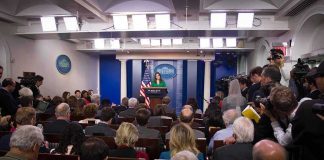
Kevin Warsh told Congress the President never asked him to promise a rate move, even as a legal shift now lets presidents fire Fed chairs for policy reasons.
Story Highlights
- Warsh denied any promise to the President on interest rates.
- Warsh said the Federal Reserve will act independently on policy.
- An ethics warning flagged pending asset disposals during hearings.
- A hypothetical “1% rate” question fueled confusion about his stance.
Warsh’s Core Claim: No White House Promises
Kevin Warsh told lawmakers that the President never asked him to commit to a specific interest rate decision. He said he would not agree to such a request anyway. His statement tracks with earlier testimony where he stressed the Federal Reserve’s independence from political pressure. This point matters because people across the spectrum fear backroom deals that tilt policy to help the few. A clear denial puts a stake in the ground that rate calls will follow data, not politics.
Lawmakers pressed Warsh on whether he promised to cut rates. Media outlets framed the moment as a test of loyalty. Warsh repeated that policy would be set by the data and the Federal Open Market Committee, not by campaign needs or White House wishes. That message aims at both conservatives tired of elite games and liberals worried about special favors. The claim is direct, simple, and checkable against future actions. The question now is whether markets believe him.
Independence Under New Legal Pressure
Warsh’s vow comes after a major legal shift that increased the President’s power over independent agencies. That change makes independence harder to hold in practice, even if the law still grants the Federal Reserve space to pursue its goals without daily interference. Research explains that Congress sets the mandate while the central bank chooses the tools, like interest rates, to meet it. This design is meant to protect long-term stability when politics pulls toward quick wins before elections.
Past presidents have pushed the central bank. Analysts have long debated how “independent” the central bank truly is, given appointment power and public pressure. Policy groups and academics note the central bank is most effective when it explains decisions clearly and avoids even the hint of political favors. Warsh’s words echo that view. He promised decisions based on the dual mandate, not on pressure. That standard gives the public a yardstick to judge his actions in the months ahead.
Open Questions: Ethics, Hypotheticals, and Missing House Record
Warsh faced an ethics compliance warning during earlier hearings. He was told that until he disposed of certain assets flagged by the ethics office, he would not be in compliance. That warning does not prove wrongdoing, but it raises trust issues across party lines. Americans are weary of leaders who say one thing and do another. Final documentation of compliance would help settle doubts. Without it, critics will keep asking if conflicts could cloud hard calls.
A viral clip showed a lawmaker asking a sharp hypothetical about slashing rates to one percent. The exchange did not include a clear answer on policy direction, which added to confusion and market chatter. That moment shows how a single soundbite can drown out a measured message. It also shows why precise language matters. When rates guide prices, jobs, and savings, even loose talk can move markets. Clear follow-up from the central bank could reduce noise and steady nerves.
Why This Matters for Families, Savers, and Small Firms
Interest rates affect mortgage payments, car loans, and credit cards. Small firms feel rate changes when they try to borrow for payroll and new gear. Warsh’s claim of independence is not just a Washington debate. It is a promise about how the central bank will weigh inflation against jobs, and how it will treat the real economy versus Wall Street. If decisions track the data, people can plan. If politics drives the wheel, costs rise and trust falls, no matter your party.
🚨 JUST IN: Fed Chair Kevin Warsh says the central bank is “racing” to meet the July 19 stablecoin rulemaking deadline.
Pressed during House testimony, he noted the $GENIUS Act was signed exactly one year ago.
Hinted the @federalreserve may not fully coordinate with other… pic.twitter.com/zFY0SWDvBf— COACHTY (@TheRealTRTalks) July 14, 2026
Next steps are concrete. First, the committee should release a full, official transcript of the House hearing. A clean record will cut spin and confirm what Warsh did and did not say. Second, the Office of Government Ethics should post the final compliance letter if complete. Third, the central bank should speak in plain words after each meeting. These basics of sunlight help citizens judge leaders on facts, not on talking points or headlines.
Sources:
bbc.com, listennotes.com, youtube.com, pbs.org, dl.icdst.org