

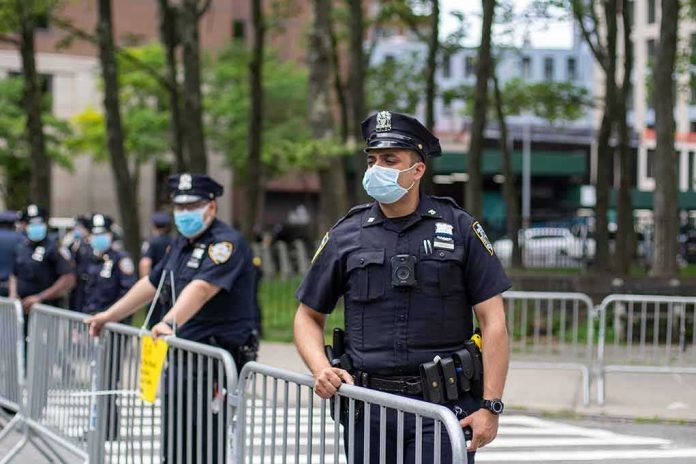
New York City has chosen a structural answer to a behavioral problem: it is pulling protest management out of a counterterrorism frame and rebuilding it around communication and de-escalation, while preserving a narrower police capability for arrests and immediate safety risks.
At a Glance
- The city is disbanding the NYPD’s Strategic Response Group (SRG) and separating protest response from counterterrorism functions.
- A civilian-led Community Dialogue and De-escalation Division will lead engagement with organizers; it will be unarmed and lack arrest powers.
- A 30-officer First Amendment Support Team (FAST) within the NYPD will provide trained, dialogue-first police capacity and handle arrests as needed.
- Union leaders and former NYPD officials warn the overhaul risks slower, weaker responses to volatile incidents, especially during the multi-year transition.
What New York Changed, and Why It Matters
The decision to decouple protest response from counterterrorism answers a persistent misalignment: treating constitutionally protected assemblies as potential terrorist incidents primes agencies to deploy coercive tools designed for rare, catastrophic threats. The announced model reorients the city toward negotiated management—advance communication, predictable ground rules, tolerance of limited disruption, and targeted enforcement—rather than a militarized crowd-control posture. The mayor’s office and NYPD jointly said the SRG will be disbanded, with counterterrorism functions reassigned and protest response built around a new civilian Community Dialogue and De-escalation Division (CDDD). A small NYPD First Amendment Support Team will backstop that approach with trained officers for liaison work and arrests when required.
This is not a retreat from all security capability; it is a reallocation with a different center of gravity. Roughly 600 SRG officers will be redistributed across the department, and the 30-officer FAST is explicitly framed as a communications-forward resource rather than a riot squad. That structure attempts to capture two goods at once: lower baseline friction with demonstrators and the ability to act when crimes occur.
The Mechanism: Dialogue-First Protest Policing
Dialogue policing is not improvisation; it is a doctrine. Agencies that practice it build formal, named liaison roles, meet organizers in advance, set mutually understood routes and expectations, and differentiate between peaceful participants and a small number of offenders. The literature calls this “negotiated management.” Reviews from RAND and other researchers find that, when applied faithfully, negotiated management protects First Amendment activity and correlates with fewer injuries, fewer arrests, and less escalation than command-and-control tactics built for deterrence and mass interdiction. The city’s plan mirrors those elements: an unarmed civilian division to engage organizers before and during events, a trained police liaison unit to bridge communication on the ground, and a narrower, clearer trigger for enforcement actions.
Why the structural split from counterterrorism? Counterterrorism units are optimized for low-frequency, high-severity events and thus carry tools, rules, and a mindset that signal danger to crowds and officers alike. Multiple studies on police militarization—distinct from counterterrorism per se but adjacent in posture and equipment—suggest such signaling can worsen public trust without measurable safety gains in routine contexts. Reassigning counterterrorism back to its specialized channels while building a separate pathway for protest management changes the default signal. It is a doctrinal reset more than a numerical cut.
The Rationale: Controversy, Law, and Operational Lessons
SRG’s protest deployments drew sustained criticism and legal challenges over tactics such as pepper spray use and mass arrests during large demonstrations, which helped crystallize the case for change. The new policy bans certain crowd-control weapons and seeks to narrow the use of force by embedding communicative steps first. The goal is not novel; it reflects a national evolution after the 2020 cycle of protests, federal after-action reviews, and city-level settlements that pushed agencies toward tiered responses, liaison functions, and clearer decision thresholds. Within that arc, New York’s move stands out not for rhetoric but for institutional design: a civilian-led division with defined scope and an NYPD unit aligned to the same theory of engagement.
The idea is operationally coherent. But coherence is not proof. The city’s announcement details structure and intent, not results. There is no pre/post use-of-force analysis yet, no injury-rate comparison, no complaint reduction data, and no time-to-resolution metrics. The claim that separating protest response from counterterrorism reduces harm is consistent with the research directionally, but it remains untested in New York’s specific environment.
The Counter-Case: Speed, Capability, and the Transition Gap
Police labor leaders and former NYPD personnel argue the overhaul weakens public safety. Their objections cluster around three practical risks. First, speed: a disbanded specialized unit, they contend, means slower, less cohesive responses when demonstrations tip toward violence. Second, capability: an unarmed civilian team without arrest power may be ill-equipped for dangerous actors hiding in peaceful crowds. Third, timing: if the civilian division will not be fully operational until 2028, the city faces a prolonged interim in which the rhetoric of civilian leadership outpaces on-the-street reality.
These are not straw-man concerns; they are operational questions any large city must answer. Commissioner Jessica Tisch framed her red line the same way—she would not support changes that leave officers without resources to confront serious threats. The plan’s authors respond partly in design: the NYPD retains arrest authority through FAST and redistributed personnel; counterterrorism remains in specialized hands; and the civilian division is meant to reduce the number of moments when force is even on the table. Whether that is sufficient for edge cases—attempted bombings, organized violence, rapidly moving flash mobs—cannot be established from announcements alone.
How to Judge Success: The Metrics That Matter
Because the transition is multi-year, the only credible way to evaluate this approach is to define and publish transparent benchmarks. The list is straightforward. For demonstrations above a set size: total arrests and charges; use-of-force incidents by type; injuries to participants, bystanders, and officers; property damage tallies; response times from first 911/311 call to on-scene liaison contact; complaint volume and disposition; and participant/organizer satisfaction. These should be tracked event-by-event and compared against a pre-policy baseline, then released quarterly. If the dialogue model works as advertised, we should see fewer force incidents and injuries, stable or improved response times, and fewer mass arrests without a rise in serious harm.
Implementation fidelity is as important as design. The city should publish the CDDD’s staffing plan, training curriculum, deployment thresholds, and incident command protocols; do the same for FAST, including communications training, arrest decision matrices, and equipment policies. Absent that, critics will fill the vacuum with hypotheticals, and supporters will have no numbers to defend the model.
🚨 MAMDANI, THE NYPD, AND A MAJOR SHIFT IN NEW YORK CITY POLICING.
On November 16, Mayor Zohran Mamdani announced the disbanding of the NYPD’s Strategic Response Group, a specialized unit involved in counterterrorism and protest response.
Its responsibilities will be…
— Maria Tokarev (@TheMariaTokarev) November 16, 2026
What Comes Next: Managing Risk Without Reverting to Old Habits
The short-term vulnerability is obvious: a high-profile violent incident during the transition would be seized on as proof the change went too far, even if causation were ambiguous. That argues for disciplined interim operations. FAST should be resourced to cover predictable peaks—major parades, campus actions, and flashpoint anniversaries—and linked tightly to patrol and specialized units for rapid handoff when crimes occur. The civilian team, as it stands up, should focus on pre-event agreements, steward networks, and rapid organizer contact trees, all of which shrink the window in which confusion metastasizes into confrontation.
The longer-term risk is subtler. If personnel, supervisors, and tacit practices simply migrate from SRG to successor formations, the reform becomes nominal. Guarding against that requires explicit doctrine and training differences, careful selection of FAST leadership, and external review of after-action reports. The opportunity, if the city follows through, is to demonstrate that protest safety and civil liberties are not trade-offs but joint products of better design. The evidence base suggests that is possible; New York now has to generate its own proof.
Sources:
facebook.com, nbcnewyork.com, reuters.com, abc27.com, fox5ny.com, cbsnews.com, jewishchronicle.timesofisrael.com, ccj.asu.edu