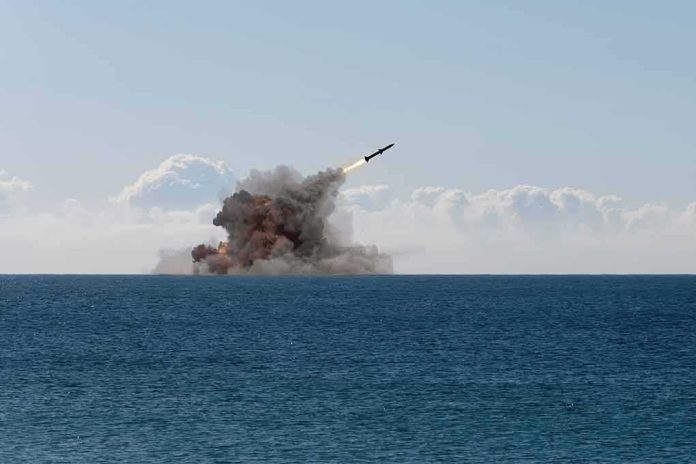
When explosions ripple across Qeshm Island and carry to Hengam and Bandar Abbas, the fact pattern that matters emerges quickly: a concentrated sequence of blasts occurred in one of the world’s most strategically sensitive corridors, even as Washington touted progress toward an Iran deal. What caused the detonations is secondary to the operational truth an expert recognizes first—an event with geographic spread and repeated counts is real, and it unfolded on the doorstep of the Strait of Hormuz.
At a Glance
- Iranian state-linked outlets reported five explosions in rapid succession on Qeshm Island; residents also described seeing aircraft overhead.
- Reports of audible blasts came from multiple locations—Qeshm, Hengam, and Bandar Abbas—indicating area-wide effects rather than an isolated incident.
- Eyewitness accounts cited five to six powerful detonations with shaking in Qeshm City.
- Coverage connected the blasts temporally to claims, sourced via U.S. officials in the Wall Street Journal and relayed by Reuters, that the United States struck Qeshm Island.
What Happened: A Concentrated Burst of Blasts in the Qeshm–Bandar Abbas Corridor
Multiple reporting streams converged on the same core development: a tight sequence of explosions on or near Qeshm Island, audible across nearby population centers. IRNA-linked coverage described “five consecutive explosions,” with the intensity suggesting impacts on the island; residents also reported two aircraft in the sky. Parallel summaries and regional monitors relayed that people in Hengam and Bandar Abbas heard the detonations as well, a detail that matters because shared acoustic experience across distinct sites is consistent with real, high-yield events rather than rumor propagation.
On-the-ground descriptions emphasized cadence and force—five to six powerful blasts and physical shaking in Qeshm City—language that coheres with munitions or intercept activity rather than a single industrial accident. Importantly, these reports arrived alongside Reuters’ write-up of a Wall Street Journal story citing U.S. officials who said the United States struck Qeshm Island, a linkage of timing that helps explain why observers immediately framed the explosions in military terms, even as attribution remained unassigned in Iranian state channels.
Why Qeshm Matters: Geography, Capabilities, and the Hormuz Chokepoint
Qeshm anchors the northern lip of the Strait of Hormuz, where roughly a fifth of the world’s seaborne oil trade passes through a maritime bottleneck bounded by Iran’s coastline and islands. The island’s terrain and infrastructure support surveillance, air defenses, and littoral interdiction; during periods of heightened tension, it functions as both shield and signal. Blasts there are not background noise. They are operationally suggestive because Qeshm sits amid air-defense sites, IRGC logistics nodes, and maritime lanes vital to Tehran’s coercive leverage.
In such settings, the same sensory signatures—booms, flashes, contrails—can correspond to several mechanisms: inbound strikes, air-defense launches, intercepts of cruise missiles or drones, or even controlled detonations. That ambiguity is not a flaw of observation; it is a feature of the battlespace, engineered by militaries that use deception, emissions control, and timing to shape what adversaries can credibly claim. Joint doctrine and scholarly analysis call this “attribution advantage”: the ability to create effects while impeding clear assignment of responsibility in the public domain.
How the Reporting Aligns: Convergence on Event, Divergence on Cause
Four elements in the record are especially probative. First, multiplicity: separate channels—IRNA-linked reporting, Fars-adjacent summaries, regional incident trackers, and Western wire services—describe explosions in the same window and geography; the points of agreement anchor the baseline. Second, count and cadence: repeated references to five or six detonations are what acoustic analysts listen for, suggesting sequenced fires or layered engagements rather than a lone blast.
Third, spatial distribution: listeners in Qeshm, Hengam, and Bandar Abbas heard the blasts, indicating propagation across the strait’s littoral arc. Sound over water carries efficiently; reports from opposite shores strengthen the inference of powerful events. Fourth, temporal framing: Reuters’ account of the Wall Street Journal’s U.S.-strike reporting arrived alongside the explosion narratives, which explains the rapid policy-focused interpretation even as Iranian outlets refrained from specifying who fired at what. One caveat belongs here, and only one: the coverage establishing that blasts occurred is firmer than any single, definitive public account of who executed which action at which site.
Mechanisms That Fit the Signatures
What could produce five to six audible, city-shaking blasts in rapid sequence on or near Qeshm? Several mechanisms fit. Sequential precision strikes against discrete targets—radars, launchers, or command nodes—would produce clustered detonations. A robust air-defense response to inbound munitions or drones can also create a string of booms: interceptor launches, mid-air interceptions, and subsequent impacts of debris or surviving projectiles. Finally, mixed engagements—strikes followed by air-defense activity—often register as a short, intense acoustic series.
Claims circulating in parallel streams alleged U.S. strikes against Iranian surface-to-air missile (SAM) sites near the chokepoint and described IRGC activity around maritime enforcement and air defenses; while those align with plausible target sets and tactics, the public reporting that stands on its own legs without further corroboration is the explosions themselves and the Reuters relay of U.S.-sourced strike claims via the Journal.
Strategic Timing: Blasts Amid Diplomatic Signaling
The explosions arrived as Washington communicated progress toward an Iran settlement—an alignment that invites strategic interpretations. Military actions near Hormuz, even when limited, send discrete messages about escalation thresholds and freedom of action; parallel diplomatic moves can be reinforced by demonstrations of reach. Conversely, local Iranian responses around Qeshm, including interdiction drills or air-defense readiness, are a predictable counter-signal intended to show resilience and control of the strait’s northern approaches. This choreography—talks on one track, kinetic risk on the other—is how statecraft and force posture often travel together in the Gulf.
Regional media have also documented a drumbeat of nighttime detonations linked to maritime enforcement and military preparations along Iran’s southern coast, which provides the ambient backdrop against which a concentrated, five-shot sequence stands out. The specificity of the Qeshm accounts—counted bursts, felt shaking, multiple towns listening—marks the difference between routine ripples and an operationally meaningful event arc.
What to Watch Next: Indicators of Scope and Intent
Several indicators will clarify how to interpret the Qeshm episode within the broader security picture. Look for commercial satellite imagery that shows scorch marks, craters, or radar-site scarring consistent with precision strikes; for shipping advisories or AIS routing anomalies that imply temporary risk aversion near the strait; and for sustained air-defense posture changes in the Bandar Abbas–Qeshm sector. Equally telling will be the density and tenor of official statements—measured language suggests limited objectives met, while accusatory or retaliatory rhetoric tends to surface when leadership assesses material damage or seeks deterrent effect.
In the interim, the analytical center of gravity is steady: multiple, closely spaced explosions occurred on or near Qeshm Island, with auditory reach into adjacent coastal nodes. That fact set, corroborated across distinct reporting lines and paired with U.S.-sourced accounts of a strike via major Western outlets, places the event firmly within the pattern of Gulf crises—kinetic moments staged against the negotiating table, each informing the other’s leverage.
US strikes hit Iran’s Qeshm Island near the Strait of Hormuz.
Iranian state media reported 5 explosions in rapid succession and residents spotting two aircraft overhead.
WSJ cites US officials confirming the limited strike, part of recent unannounced actions, while IRGC… pic.twitter.com/u2hUMEeK2b
— Gina Beana Fofina (@Ginasassyass) November 3, 2026
Bottom Line
Qeshm is where signals become strategy. A burst of five or six blasts heard across the strait is not ambient noise; it is the sound of military and diplomatic instruments playing in time. The reporting record establishes the event with confidence, and its location—on Iran’s forward rim at Hormuz—makes it consequential for energy markets, naval routing, and any negotiation premised on leverage. In the Gulf, effects come first, explanations later; experts read the sequence, the geography, and the timing to understand intent.
Sources:
townhall.com, newsquawk.com, rmb.reuters.com, iran.liveuamap.com, hamerintel.com, investinglive.com, iranintl.com