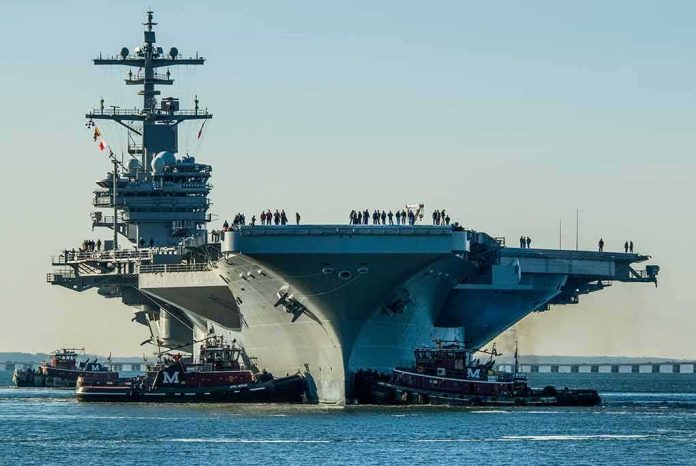
The real question hanging over USS Gerald R. Ford isn’t whether the Navy’s largest warship will leave the shipyard in early 2027 — it’s whether “leaving the shipyard” and “ready for combat” mean the same thing, and history says they rarely do.
Key Points
- Ford entered Norfolk Naval Shipyard after a record 326-day deployment to repair fire damage, roughly 100 damaged berths, and a chronically failing vacuum wastewater system that logged 205 toilet breakdowns in four days
- The Navy says the maintenance period is on pace to finish early, but a reported $17.6 million repair contract runs through March 2027, and sea trials, recertification, and air-wing workups still follow shipyard completion
- Government Accountability Office data show public shipyards completed only 25 percent of carrier and submarine maintenance periods on time in recent years, with carrier availabilities averaging 113 days late
- Defense analysts cited in multiple outlets estimate Ford’s actual return to full readiness could stretch into mid-to-late 2027 rather than the Navy’s early-2027 projection
What Sent the Navy’s Newest Carrier Back to the Yard
Gerald R. Ford, the lead ship of a class the Navy spent more than a decade and roughly $13 billion developing, returned to Naval Station Norfolk after 326 days at sea — the longest carrier deployment since Vietnam. It came home carrying damage from a March 12 laundry-room fire that injured sailors with smoke and destroyed roughly 100 berths, plus a vacuum wastewater system that had become a running joke and a genuine readiness problem: 205 toilet breakdowns in four days, 42 assistance calls since 2023, 32 of them in 2025 alone. Chief of Naval Operations Adm. Daryl Caudle has pushed back on the plumbing narrative, calling it “highly exaggerated” and attributing much of it to wear from an unusually long deployment rather than a design flaw. The Navy has stated the current availability — which includes modernization work alongside these repairs — is “set to finish early”.
That framing matters because it is doing a lot of work. A repair contract tied to this availability reportedly runs through March 2027, which already sits later than “early 2027” as most people would read that phrase. Reconciling a contract period-of-performance with a public timeline that implies the ship sails sooner is the kind of gap that invites scrutiny, and it has.
Why Shipyard Completion Isn’t the Same as Combat Readiness
Carrier maintenance has a sequence, and it is not optional. The Navy’s own account of Ford’s 2019 post-shakedown availability lays it out: fifteen months of pierside work, then a multi-day “Fast Cruise” to shake the ship down alongside the pier, then sea trials to validate maintained and modified systems, and only after that postdelivery testing to certify fuel systems, aircraft compatibility, the flight deck, and combat systems. Ford repeated a compressed version of this cycle in 2022, completing its inaugural Planned Incremental Availability and then sea trials over roughly six months. Neither case supports treating a shipyard exit date as an operational return date — they’re sequential, not simultaneous, and the gap between them has historically run months, not days.
That distinction is exactly where the current dispute lives. Industry and Navy-adjacent reporting frames early 2027 as the shipyard-completion target. Defense commentary, by contrast, treats early 2027 as, at best, the date Ford leaves the pier — with sea trials, recertification, and training still ahead of it. The National Interest put it bluntly: even a “near-miraculous” six-month availability would still leave several months of post-availability sea trials, training, and certification before the ship could take on a real mission, pushing genuine readiness into late 2027.
What the Track Record Actually Shows
This isn’t a dispute that has to be settled by competing guesses, because the Navy’s own maintenance performance has a documented history, and it is not encouraging. The Government Accountability Office found that public shipyards completed only 47 percent of aircraft-carrier maintenance periods on schedule between fiscal years 2000 and 2016, and that for fiscal years 2015 through 2019, 75 percent of carrier and submarine maintenance periods finished late, averaging 113 days of delay per carrier availability. An earlier GAO review found eight of nine carrier availabilities — 89 percent — ran over schedule between fiscal years 2011 and 2014, costing an average of 65 lost operational days each. Those are not cherry-picked outliers; they are the Navy’s recent normal. Analysts writing about Ford have leaned on exactly this base rate: Jack Buckby warned of a plausible 12-to-14-month maintenance window given the fire, the deferred maintenance, and the long deployment combined, while Warrior Maven described a repair scope — overhauling the vacuum-waste system, replacing worn pumps and valves, inspecting propulsion shafts and steam-distribution equipment — broad enough to plausibly run “many months, and possibly more than a year”. 19FortyFive split the difference explicitly: early 2027 if the yard hits its normal schedule, middle-to-late 2027 if Ford follows the pattern recent carriers have actually set.
Where That Leaves the Schedule
None of this means the Navy’s early-2027 statement is false — a shipyard period can genuinely finish ahead of plan, and the service has pulled off faster-than-expected turnarounds before. But the specific, documented counter-case here is stronger than generic skepticism: it rests on GAO’s own multi-year delay statistics, on named analysts citing concrete repair scope, and on the plain sequencing the Navy itself has described in prior Ford availabilities. The honest reading is that “early 2027” most likely describes when Ford leaves Norfolk Naval Shipyard, not when it is certified, trained, and combat-ready — and the gap between those two moments, going by every comparable Ford-class and recent carrier availability on record, has reliably been measured in months. Anyone tracking when this carrier is actually available for tasking should watch for the sea-trial announcement and the certification milestones that follow it, not the shipyard-exit date alone.
Sources:
19fortyfive.com, navytimes.com, ground.news, navy.mil, nhpr.org, kpbs.org, ibtimes.co.uk, gao.gov