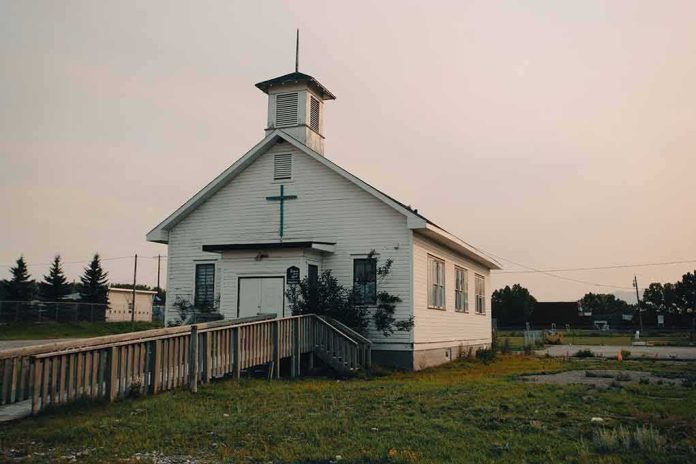
When armed coalitions treat displacement sites and churches as kill zones, the message is not random brutality but territorial governance by terror — and in Kenscoff, Haiti, that logic produced at least 47 dead and more than 50 kidnapped in a single night.
At a Glance
- UN officials report at least 47 people killed and dozens abducted in an overnight gang assault on Kenscoff, with victims including children and people sheltering in a church compound.
- The attack is consistent with Haiti’s broader pattern: gangs projecting control by striking civilians in displacement sites and along key corridors around Port-au-Prince.
- Haiti’s police and military capacity remains outmatched; international efforts have not dismantled major gang structures or reduced displacement at scale.
- Strategic geography matters: Kenscoff sits on vital routes and agricultural supply lines, making it a predictable target as coalitions fight to expand terrain and taxation.
What happened in Kenscoff — and why it matters
During the night of 23 to 24 August, armed men attacked Kenscoff, in the hills above Port-au-Prince. According to the UN Special Representative briefing the Security Council, at least 47 people were killed — among them children — with dozens abducted and many others injured. The UN and humanitarian statements specify that a portion of the dead were executed inside a church compound where displaced families had sought safety, a detail that captures both the attackers’ intent and the victims’ vulnerability. The brutality is not an aberration; it is a tactic. Striking a shelter signals to communities that there are no sanctuaries, only zones temporarily spared.
This single incident sits within a national emergency defined by mass displacement and gang rule. UN reporting in mid-2026 put displacement near 1.5 million, an extraordinary share in a country of roughly 11 million, linked directly to gang violence and the collapse of routine state protection in and around the capital. The specific numbers in Kenscoff — dead, wounded, kidnapped — matter, but so does the grammar of the attack: a night raid on a community that controls a corridor, with a church compound used as a refuge turned into an execution ground. That grammar has repeated across the metropolitan area for years.
The mechanism: how gang coalitions govern by force
Haitian armed groups are not ad hoc mobs; they are coalitions with division of labor, access to arms, and a theory of control. Their portfolio includes racketeering, kidnapping, selective massacres, and strategic arson — tools for extracting revenue and dictating movement. Human Rights Watch describes how the Viv Ansanm coalition consolidated control over most of Port-au-Prince and expanded into multiple departments, sustaining a steady tempo of abuses: killings, sexual violence, and forced recruitment of children. This is coercive governance: dominance over markets, roads, and urban peripheries, not mere spree violence.
Displacement is both consequence and instrument. Push civilians out, seize their neighborhoods, and tax the flows that replace settled communities: relief distributions, transport convoys, remittances, fuel. In that setting, a church sheltering the newly displaced is not off-limits — it is a visible node where fear can be maximized at low operational cost. The Kenscoff raid, which left dozens abducted alongside the dead, aligns with the revenue logic; hostages are liquidity. The UN’s June figures on killings and displacement outline the ambient pressure: thousands dead this year, vast dislocation, and a city functionally segmented by gang fiefdoms.
Why Kenscoff is a target: terrain, corridors, and food
Kenscoff’s geography amplifies the message. It is a hilly, vegetated area overlooking an affluent corridor and one of the few remaining routes linking the capital to the southeast. Control over that road is not symbolic; it determines who eats, who pays, and who moves. Reporting around the attack underscores how gangs have leveraged the terrain — mist, cover, broken sightlines — and firepower to offset state surveillance and sporadic security sweeps. As international briefings have emphasized, gangs’ coordinated operations across the capital and key economic corridors have strained police and humanitarian capacity to the limit. The agricultural significance of the area compounds the stakes: hold Kenscoff and you can tax produce, choke supplies, and bargain from strength.
Capacity versus tempo: why security responses lag outcomes
Haiti’s policing challenge is structural, not episodic. Under-resourced units face adversaries armed with automatic weapons and increasingly comfortable with drones and radios. Coalition discipline allows rapid massing at night and dispersal at dawn. Even where international support has enabled gains in parts of downtown Port-au-Prince, gangs have retained depth positions in the periphery, shifted revenue sources, and timed attacks for maximum psychological effect. UN system reporting has consistently linked the growth of gang influence to escalating displacement; the feedback loop is vicious and self-reinforcing. In that context, the absence of high-value arrests over long stretches is not an aberration; it is a symptom of the state’s degraded reach and the coalitions’ counterintelligence and intimidation capacity.
What the numbers say — and what they do not
In Haiti’s crisis environment, casualty counts often move as investigators reach sites, families reclaim bodies, and abductees surface. But the direction of travel is not in doubt. The Security Council briefing placed the Kenscoff toll at 47 killed with dozens abducted, including children among the dead. Separate UN communications during the summer described a country where roughly 1.5 million people are unstably housed and thousands have been killed this year, figures that explain both the visibility of displacement sites and their attractiveness to attackers. Precision on the margins will always lag; the structural indicators do not.
What this means for civilians, the church, and humanitarian corridors
When a church compound is turned into a site of execution, every school, clinic, and parish hall doubling as shelter becomes suspect in the public imagination. That fear has operational effects: families avoid formal sites, disperse into brush or informal encampments, and become harder to reach with aid. Humanitarian agencies then face a double bind — protect staff in contested areas while keeping lifelines open. The Kenscoff raid will push more displacement south and east, test relief convoys on the remaining open corridors, and likely strengthen gang bargaining power in rackets tied to movement and supply. It will also harden the church’s pastoral calculus; parishes will not stop sheltering people, but the physical security model must change — more dispersion, more coordination with any credible local protection partners, and stricter entry controls.
A recent massacre in Kenscoff, near Port-au-Prince, killed at least 47 people and more than 52 people were abducted. The UN says some victims were killed after taking refuge in a church.#HAITI pic.twitter.com/NpohqnjHBG
— Sarå (@aimdow) August 29, 2026
The path forward: deny sanctuary to violence, restore it to civilians
There is a clear, if difficult, hierarchy of needs. First, detach displacement nodes from predictably lethal patterns: vary relief schedules and routes; use smaller, more frequent distributions; blend community watch structures with professional security where possible; and keep shelters off major chokepoints. Second, degrade the coalitions’ revenue engines — kidnapping and corridor taxation — with focused interdictions that leverage financial tracking and targeted arrests rather than episodic sweeps that announce themselves days in advance. Third, integrate early-warning mechanisms tied to terrain — drones and towers matter, but human networks and reliable communications matter more.
The Kenscoff massacre is a discrete event with a known shape: night, hills, corridor, church, executions, kidnappings. It is also a template. Breaking it requires treating Haiti’s gang coalitions as the political-economy actors they are — organizations that calculate return on violence — and then lowering that return decisively. Until that happens, churches and displacement sites will remain what the attackers intend them to be: billboards of fear.
Sources:
pjmedia.com, amnesty.org, dw.com, nytimes.com, youtube.com