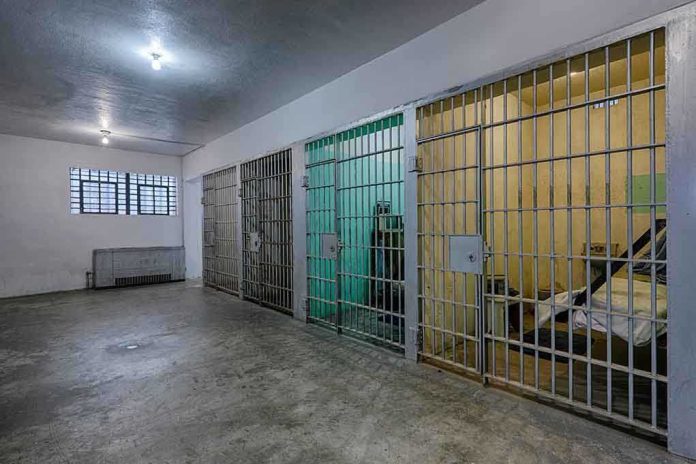
Immigration enforcement lives or dies on throughput, and in the United States that throughput is gated first by custody space; Tom Homan’s mantra—“Get them out quick. Open those beds up”—isn’t a slogan so much as a capacity argument for how large-scale removals actually move from promise to completion.
The Short Version
- Homan’s plan hinges on expanding ICE detention to roughly 100,000 beds so custody, court, and transport can run as a single, high-throughput pipeline.
- He ties that bed count to a 30–40 day average detention period, claiming it supports removals on the scale of a million annually if the rest of the system stays synchronized.
- Public reporting shows present capacity trailing far below that target, with bed ceilings periodically forcing releases—a practical brake on enforcement tempo.
- Rights advocates and legal scholars contest the bed-build premise on due process, cost, and quota concerns; they press for alternatives to detention and individualized custody decisions.
What Homan is really arguing: detention as the binding constraint
In Homan’s framing, detention capacity is the chokepoint that dictates whether an administration can translate arrest surges into finished removals. He has reiterated a 100,000-bed floor since late 2024, explicitly linking that inventory to a 30–40 day average detention stay and, by extension, to the math of annual removals at six or seven figures. The logic is mechanical: more admissible arrests flowing into custody, swift adjudication for those in proceedings, and rapid removal—then refill the vacated bed and repeat.
That argument assumes detention is not an isolated input but the first station in a tightly coupled chain. A bed enables reliable court scheduling, consistent access to the person for interviews and travel documentation, and controlled handoff to outbound transport. Remove the bed and every subsequent step—service of process, court appearance, staging for flights—gets slower and less certain. Homan’s punchy phrase about “opening those beds up” is thus shorthand for increasing cycle speed through custody, not merely warehousing people.
The capacity gap: what the public record shows
Independent coverage has treated the “more beds” refrain as a sustained, not episodic, position. CNN and NBC described funded bed counts well below Homan’s target during 2024–2026, while the Washington Times documented situations where ICE hit bed limits and released people—an operational signal that capacity ceilings are binding on field decisions. Homan has also paired his bed target with calls for more ICE officers and additional facilities, acknowledging that custody space without people and places to run it is merely a number on paper.
The most specific throughput claim comes from his on-record tie between 100,000 beds and a 30–40 day average detention length “equalling over a million removals.” That line is policy arithmetic, not a published DHS model; no underlying operational analysis, queueing assumptions, or failure-rate estimates for travel documents and court outcomes have been made public alongside it. The absence of a disclosed model does not negate the plausibility of the mechanism, but it does limit how confidently one can assess year-long output from a single-input target.
How the pipeline works when it works
In an enforcement-first architecture, detention inventory is managed like manufacturing work-in-process. The operational aim is to minimize dwell time that does not advance the case while preserving due process and case integrity. In custody, charging documents can be served; credible-fear and other screenings are scheduled; and, crucially, the person is present for court, consular interviews, and travel coordination. Homan has asserted that detained dockets move quickly—he has cited roughly five weeks to a hearing, followed by removal when ordered—though the sources at hand do not supply courtwide docket data to verify that timescale at scale.
When facilities fill, field offices shift to triage: prioritize criminal cases and mandatory detainees, then lean on releases or alternatives to detention for others. That is when the system’s friction becomes visible—missed hearings, lengthened timelines, and more difficult logistics. Reports of ICE hitting bed limits and releasing migrants capture that moment when the pipeline’s first station constrains the rest.
The contested terrain: quotas, due process, and alternatives
The counter-case is not a quibble about arithmetic; it challenges the premise that scaling beds is the right lever. Advocacy groups and legal scholars have long criticized what they describe as a de facto bed quota—appropriations language that encouraged ICE to maintain a fixed daily population—arguing that such targets are arbitrary and incongruent with individualized custody decisions required by due process. They also contend that detention conditions and attorney access remain inconsistent, and press for investment in alternatives to detention (ATDs) such as case management, reporting, and electronic monitoring, pointing to international practice and U.S. pilots as evidence that compliance can be achieved without custody for many populations.
These critiques do not directly refute Homan’s claim that more beds would increase throughput if used; rather, they argue that throughput alone is not a sufficient success metric. They reframe the objective around legality, proportionality, and cost-effectiveness: who must be detained to ensure appearance and removal, for how long, at what humanitarian and fiscal cost, and with what demonstrable benefit compared with non-custodial options. On those comparative questions, the public materials tied to Homan’s 100,000-bed figure are thin—no cost-per-removal comparisons, no randomized or matched-cohort court appearance data, no procurement and oversight plan that anticipates the well-documented contracting pitfalls in ICE’s decentralized facility network.
Numbers without a model are vulnerable
Homan’s specificity—100,000 beds, 30–40 days—creates clarity and invites accountability. It also creates a target for critics because the sources available attribute the numbers to his statements rather than a released ICE capacity model or DHS planning memo. Without a public denominator—detained versus non-detained case mix, failure rates for travel documents, removal order conversion rates, and court capacity—one cannot test whether 100,000 is a minimum, an average, or a political round number. That evidentiary gap is why the claim travels quickly in media while remaining contestable in policy forums.
The same problem shadows performance boasts. Homan has said ICE arrests and removals hit record levels and that detention accelerates outcomes, but those assertions in the cited clips come without links to the official tables or docket analytics that would let outside analysts validate the causal chain. For a capacity-led strategy to survive oversight, the model must be disclosed: bed inventory assumptions, court slot allocations, removal-flight lift, consular document cycle times, and fallback rates to ATDs when the system saturates.
WATCH: Border Czar @RealTomHoman rebuffs Dana Bash's appeals to emotion in opposition to deportations of Haitians after the expiry of TPS.
DANA BASH: The Department of Homeland Security sent two deportation flights to Haiti over the past two weeks. Haiti is a country that a… pic.twitter.com/pdvyoi4Rfj
— Jorge Bonilla (@BonillaJL) August 30, 2026
What a serious plan would surface—and why it matters
If the policy aim is enforcement at scale with legitimacy, three disclosures would move the debate from slogans to governance. First, a transparent throughput model linking beds, detention length, court capacity, and transport, with sensitivity tests for bottlenecks; this is the only way to evaluate the 100,000-bed claim on its own terms. Second, comparative evidence: detained versus supervised-release cohorts on appearance rates, time-to-decision, and ultimate removals, with costs for each mode over the case lifecycle; otherwise, “more beds” remains a preference statement, not a demonstrated optimum. Third, a contracting and oversight blueprint aligned with GAO’s findings on ICE’s patchwork acquisition methods; rapid expansion without disciplined procurement and monitoring is where cost overruns and conditions failures emerge.
Homan’s core contention—that custody is the binding constraint in a high-tempo removal regime—is operationally coherent, and current reporting supports the existence of a capacity shortfall that periodically forces release decisions. Whether that shortfall should be closed with tens of thousands of new beds or with a redesigned custody triage that leans more on alternatives is the unresolved policy choice. It will not be resolved by another viral clip. It will be resolved, if at all, by the release of the math, the costs, and the tradeoffs.
Sources:
redstate.com, thenationaldesk.com, cnn.com, washingtontimes.com, the-independent.com, kmjnow.com, wsws.org, nbcnews.com, ccrjustice.org, aclu.org, oas.org, americanimmigrationcouncil.org, detentionwatchnetwork.org, immigrantjustice.org