

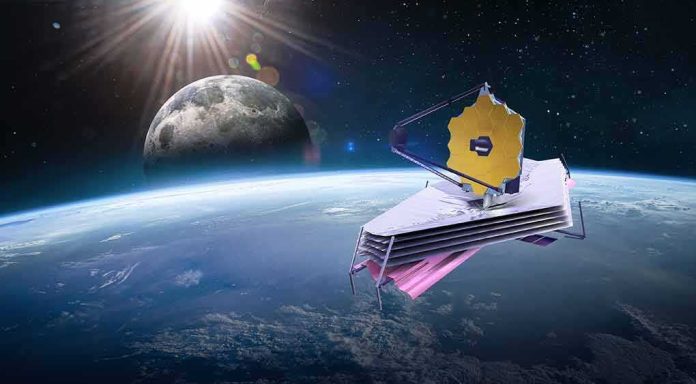
NASA’s Nancy Grace Roman Space Telescope is now on its way to the Sun–Earth L2 point, beginning a flagship observatory mission designed to map the cosmos at scale, probe dark energy and dark matter, and expand the census of exoplanets with instrumentation purpose-built for the job.
At a Glance
- Roman launched aboard a SpaceX Falcon Heavy from LC-39A at Kennedy Space Center, at 7:26 a.m. Eastern, beginning its cruise to L2.
- The observatory couples a 2.4-meter mirror with a wide-field camera roughly 300 megapixels in size, enabling sky surveys hundreds to a thousand times faster than Hubble’s.
- Early operations include solar array deployment, trajectory corrections, antenna deployment, and a months-long commissioning before first science.
- Roman’s wide-field cosmology program and its coronagraph technology demo aim to sharpen measurements of cosmic acceleration and pioneer direct imaging techniques for exoplanets.
What launched, and why it matters
Roman is NASA’s next great survey telescope. It flew aboard SpaceX’s Falcon Heavy, a triple-core launch vehicle whose high-energy performance and fairing volume match Roman’s mass and envelope constraints, lifting off from Launch Complex 39A at the precise target time after a standard series of polls and propellant loading milestones. NASA’s mission integration, encapsulation inside the payload fairing, rollout, and final “go” to proceed were executed in the days leading up to the countdown, closing out a multi-year development cycle and setting the observatory on a transfer trajectory toward the Lagrange 2 region about a million miles from Earth. The independent tracking community and real-time launch coverage corroborated the targeted liftoff time and the mission profile to L2.
The point of building a wide-field infrared survey telescope is simple and profound: cosmology and exoplanet science increasingly need statistics, not snapshots. Roman’s optical train leverages a Hubble-class 2.4-meter primary mirror mated to a focal plane designed for panoramic imaging in near-infrared bands, capturing cosmological structure and transient phenomena over enormous swaths of sky with high spatial resolution. That scale is the unlock—where Hubble excels at deep, narrow cones, Roman will trace the cosmic web, weak gravitational lensing, and supernova populations across wide fields to constrain dark energy models with far tighter error bars.
How the mission gets on orbit and comes alive
Launch is the opening move, not the checkmate. Falcon Heavy’s ascent profile included side-booster separation, fairing jettison, second-stage burns, and the deployment event placing Roman on its L2 transfer. From there, spacecraft operations take over: solar array deployment to achieve a power-positive state, attitude stabilization, initial health checks, and trajectory correction maneuvers to refine the cruise to the L2 halo orbit. NASA’s description of Roman’s early operations underscores a modern reality in spaceflight: “success” is confirmed cumulatively across separation, power, thermal, guidance, and communications subsystems in the first days and weeks, and then more comprehensively during commissioning. Artemis I’s post-flight analysis cycle is instructive here—engineering teams validated performance through staged data reviews long after the last plume had faded from the pad.
At L2, Roman will carry out a carefully sequenced observatory commissioning. The wide-field instrument (WFI)—a roughly 300-megapixel imager tiered with filters and grism elements for photometry and slitless spectroscopy—will undergo alignments, detector characterization, and calibration campaigns before survey operations. The high-gain antenna will come online to support high-volume downlink; Roman is designed to return on the order of a terabyte per day of science data once in full swing. The mission’s coronagraph instrument, a technology demonstration riding with the main science payload, will execute its own commissioning steps to validate starlight suppression and wavefront control techniques that enable direct imaging of dim planets close to bright host stars.
The science Roman is built to do
Roman’s cosmology program combines three complementary probes: weak gravitational lensing to map mass distributions via subtle distortions in galaxy shapes, baryon acoustic oscillations (BAO) to use large-scale structure as a standard ruler, and Type Ia supernovae as standard candles to track the expansion history. Each probe alone constrains combinations of parameters—dark energy’s equation-of-state, matter density, curvature—but together, across enormous survey volumes, they break degeneracies that have limited precision to date. This is the systematic approach the field has matured into since Hubble’s deep fields and the supernova accelerations of the late 1990s; Roman is the instrument that scales those methods.
On the exoplanet front, Roman’s discovery engine is gravitational microlensing—sensitive to planets further from their stars and to lower masses than the transit and radial velocity methods favor. By monitoring dense star fields toward the Galactic bulge with exquisite cadence and resolution over wide fields, Roman will expand the census of cold and free-floating planets, providing the missing demographics needed to test planet formation models. The onboard coronagraph, while not a prime survey instrument, is a pathfinder for high-contrast imaging—advancing deformable mirrors, coronagraph masks, and control algorithms—laying technical groundwork for future missions that aim to directly image Earth-like worlds.
Hardware lineage and the partnership model
Roman’s 2.4-meter mirror class evokes Hubble, and for good reason: NASA leveraged heritage optics and institutional experience to accelerate schedule and reduce cost and risk in the optical assembly, while designing entirely new wide-field instrumentation and spacecraft systems for survey speed and stability. That architectural choice—heritage where it counts, novelty where it multiplies science return—reflects a broader programmatic lesson: focus bespoke engineering on the parts that change the problem’s scale.
The launch architecture follows a similarly pragmatic line. Falcon Heavy offers the mass-to-escape capability and fairing volume Roman needs, along with a cadence and integration flow that NASA’s Launch Services Program has vetted across multiple high-value science payloads. Prelaunch milestones—flight readiness review, encapsulation, rollout, fueling, and terminal count—were tracked publicly by NASA and SpaceX, culminating in a to-the-second liftoff from LC-39A. Space.com’s live coverage and the launch community’s databases aligned on the timing and the L2-bound trajectory, reflecting the mission’s straightforward ascent profile to a transfer orbit.
From liftoff to legacy: how Roman will change the map
Once science operations begin, Roman will produce uniform, high-fidelity sky maps that become reference layers for a generation. Weak-lensing shape catalogs on billions of galaxies will drive precision cosmology; time-domain surveys will catch supernovae and other transients in the act; deep, dust-piercing near-infrared imaging will connect star formation across environments. Just as Sloan Digital Sky Survey data reshaped extragalactic astronomy by making comprehensive maps routine, Roman’s data volume and quality will turn today’s flagship analyses into tomorrow’s standard tools.
It will also change how we coordinate observatories. Roman’s wide-field context will feed target selection and interpretation for Webb’s narrow, ultra-deep instruments and for ground-based extremely large telescopes. That is the complementary ecosystem NASA designed: panoramic discovery and characterization at scale, followed by forensic detail where the physics demands it. The payoff is not one headline image—though those will come—but the steady tightening of uncertainties until once-speculative models either stand or fall.
Congratulations to NASA and SpaceX on a successful launch of the Roman Space Telescope
— Cece (@_CeceMary) August 30, 2026
What to watch next
In the near term, the milestones worth tracking are prosaic and decisive: propulsion and navigation updates during cruise; the completion of solar array and antenna deployments; thermal stabilization; and instrument commissioning checkouts. Expect first-light images after commissioning rather than during cruise, with full survey operations beginning only once calibrations lock in. That pacing reflects modern high-consequence missions across NASA’s portfolio—analysis confirms success, not the camera angle at liftoff. When Roman’s first public datasets land, they will not merely be beautiful—they will be statistically powerful, which is the point.
Sources:
en.wikipedia.org, science.nasa.gov, spacex.com, space.com