

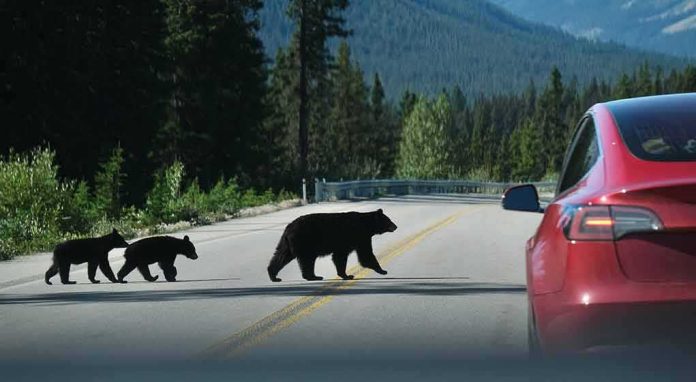
When natural forage fails at scale, black bears do not vanish into the backcountry; they follow calories—into towns, across suburbs, and sometimes straight through restaurant districts. Drought compresses wild food webs, and in poor food years the urban pantry of trash, birdseed, pet food, orchards, and unsecured garages reliably fills the gap.
The Short Version
- Wildlife agencies across the interior West report sharp year-over-year surges in bear reports during drought years; Colorado’s 2026 tally was on a record-setting pace by mid-August.
- Drought reduces berry, mast, and insect production, pushing bears to range farther and exploit human food sources—an effect documented repeatedly in field studies.
- Urban attractants and decades of exurban growth magnify drought’s signal; bears learn fast where food is reliable, and they return until it is secured or removed.
- The pattern is cyclical and partially reversible: when natural foods rebound, urban use drops—but only if attractants are controlled.
What is driving the surge: the biology of scarcity and opportunity
Black bears are generalist foragers with a seasonal strategy built around hyperphagia, the autumn binge that stocks fat for denning. In years when serviceberry, chokecherry, acorns, and other mast are abundant, bears can meet those caloric targets largely on wild foods. Drought interrupts that plan by reducing fruit set and nut production, thinning insects, and delaying or shrinking soft mast. In that context, an unsecured trash enclosure or backyard apple tree is not a temptation; it is a predictable energy jackpot. Field research has mapped this shift with precision: bears use higher human-density areas and become more nocturnal in poor food years, then retreat to wild forage when it rebounds. A Colorado Front Range study similarly found that bears foraged extensively in town when natural production was poor, switching back when wild foods recovered.
Agency data show the behavioral pivot playing out at scale. Colorado Parks and Wildlife (CPW) reported more than 6,000 bear reports by mid-August 2026—roughly double the same period a year earlier—and explicitly tied the spike to extreme drought limiting natural foods and pushing bears into neighborhoods. Local field officers said the pattern was statewide, from the High Country into Front Range cities, as bears ranged farther and took more risks to meet energy needs. Those reports are not all dangerous encounters; they include sightings, property damage, and conflicts. But their direction—up sharply during an unusually dry year—is consistent with what the biology predicts.
How we got here: drought pressure layered onto decades of edge growth
It is too simple to say drought “causes” urban bears; drought lights up the existing wiring. The last generation has seen steady exurban growth into what biologists call the wildland–urban interface—precisely the oak, aspen, and riparian mosaics bears favor. Edge habitats carry both natural foods and a density of human ones: trash, grills, compost, livestock feed, fruiting ornamentals. In that setting, a poor berry year does not just send bears “to town”; it shortens the distance to the next reliable calorie and increases the payoff for risk-taking. A Journal of Mammalogy study in Missoula cut through the complexity: variation in urban food availability best explained when bears foraged near houses.
Population history matters as well. Recovered game management and hunting controls lifted American black bear numbers across many states over the last half-century, expanding the pool of dispersing juveniles and the chance of human contact in any given season. When drought layers onto that demographic base—especially alongside wildfire that temporarily displaces animals and incinerates berry shrubs—the conflict curve steepens. Colorado’s 2026 season combined all three: low snowpack, active fires, and regional drought that left shrubs underproducing, a confluence CPW and regional outlets called out directly.
What the strongest studies actually show
The cleanest science on urban-use shifts uses two lenses: behavior within seasons and population-level consequences across years. On behavior, multiple independent teams have shown that black bears opportunistically switch into urban foraging during poor natural food years and then switch back when wild foods return, often adopting more nocturnal activity to avoid people while still exploiting urban calories. On population consequences, a study at the development–wildland interface during a natural food shortage documented a 57% reduction in female abundance and altered space use—evidence that repeated poor-food years can produce real demographic strain even as urban resources prop up short-term foraging. The through-line is clear: human foods are a safety valve bears will use aggressively in scarcity, but they are not a biological substitute for resilient wild forage.
Modeling and management studies add nuance without softening the core point. A UC Berkeley analysis during California’s 2012–2016 drought linked increased urban use to the dry years; a Colorado–Aspen collaboration highlighted that management levers—trash control, timing of hazing or aversive conditioning, bear-proofing requirements—can dampen the urban pull even in poor-food seasons. And statewide incident tallies in the West during formally declared droughts show the same broad association: more reports when precipitation drops and mast fails, especially in autumn.
Why “record reports” do not require a mystery explanation
Every drought surge invites a counterfactual: maybe there are simply more people reporting, better apps, or changed definitions. Those factors always contribute at the margins; agencies have modernized intake systems and public awareness waxes and wanes. But they do not erase the ecological drivers visible on the ground. When shrub crops fail, bears shift ranges, show up earlier and later in the day, and begin testing every predictable attractant. Colorado’s year-over-year signal—a near doubling of reports through mid-August 2026, with officers simultaneously documenting failed soft mast and fire-displaced wildlife—cannot be reduced to paperwork alone. In ecosystem work, triangulation matters: field signs, diet shifts, camera traps, and incident patterns all point in the same direction.
What this means for communities: mitigation that actually works
The practical implication is refreshingly non-theoretical. If drought is tightening wild food budgets—and the data and field observations say it is—then the only durable way to keep bears out of neighborhoods is to starve the urban buffet. Communities that standardize bear-resistant containers, enforce pickup timing, remove or electrify fruit trees and small livestock enclosures, and cite unsecured attractants reduce conflicts markedly, even in poor-food years. Where those measures lag, bears learn street-by-street which alleys and cul-de-sacs pay, and they return. The literature is blunt: urban food availability best predicts near-house foraging; change that predictor and you change behavior.
Management strategy then layers on seasonality. In early hyperphagia, consistent hazing and swift removal of food rewards can keep naïve juveniles from learning bad routes. Later in a severe drought year, triage matters: focus enforcement and outreach on the highest-conflict corridors—edges near riparian patches, older fruiting neighborhoods, and foothill subdivisions—until natural foods, if they do, improve. Because the urban-use shift is reversible when mast returns, the goal is to prevent the reinforcement cycle—one successful trash raid becomes ten—during the lean window.
Bears are being driven into US towns in record numbers after drought
Bears are interacting with humans more often across the country after the driest winter in memory wiped out around 90% of their diet, according to bear experts and state wildlife agencies, which say it's leading… pic.twitter.com/1AGUPkjPRE— Steve Ruud (@ruud_steve9838) August 29, 2026
The bottom line
Record bear reports in U.S. towns during drought years are not an enigma; they are the predictable outcome of a large, adaptable omnivore meeting a landscape where wild calories crash and urban calories sit unsecured. Drought is the accelerator; development patterns and attractants are the roadway. Communities cannot control regional precipitation, but they can close the pantry. Where they do, the spikes flatten. Where they do not, the bears will keep coming—until the shrubs recover or the food rewards end, whichever arrives first.
Sources:
youtube.com, coloradoan.com, kkco11news.com, sciencedirect.com, mountainscholar.org, escholarship.org, inews.zoombangla.com, coloradosun.com, cbsnews.com, landwildlifereport.com