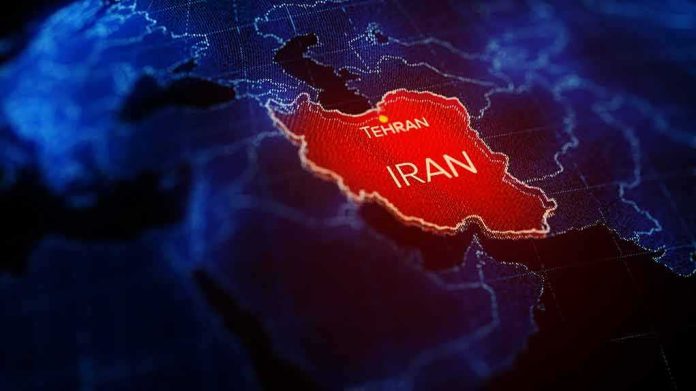
Washington’s turn to “economic warfare” against Iran is not an improvisation born of battlefield fatigue; it is the reactivation and escalation of a mature sanctions machine designed to constrict Tehran’s access to oil revenues, dollars, shipping, insurance, and now even digital asset rails — a strategy President Trump has explicitly chosen to prioritize over new military strikes.
At a Glance
- President Trump has shifted the Iran campaign’s center of gravity to financial pressure, vowing unprecedented sanctions while maintaining naval measures to strangle oil exports.
- Treasury’s toolset blends classic oil, banking, shipping, and insurance restrictions with newer actions against crypto-linked networks that Tehran uses to skirt controls.
- Sanctions reliably inflict economic pain; their record at forcing strategic concessions is mixed and tends to decay over time, especially absent broad multilateral enforcement.
- The gambit trades immediate kinetic risks for slower-burn coercion — with knock-on effects for global energy markets, third-country exposure to secondary sanctions, and regional maritime security.
What Washington is doing: sanctions as the main effort, not the sideshow
After months of strikes, interdictions, and a blockade posture around Iranian oil flows, President Trump has framed the next phase plainly: lower the military profile and let economics bite. In interviews and briefings, he has emphasized “low-keying it” while highlighting Iranian inflation, financing constraints, and difficulty accessing reserves abroad. That rhetoric has been paired with promises — from both the President and Treasury Secretary Scott Bessent — of measures “never seen” before, signaling a step-change in scope and enforcement tempo. The core objective is familiar: throttle oil exports, choke dollar and euro clearing, complicate insurance and reinsurance for vessels carrying Iranian crude, and expand penalties on intermediaries that keep the regime financially connected.
The newest wrinkle is digital finance. State Department releases describe sanctions on exchanges and facilitators tied to Iranian illicit finance — a recognition that evasion no longer runs only through front companies, ghost tankers, and barter but also through crypto rails that can convert value and obscure provenance. Designations of exchanges, networks, and principals aim to raise the compliance temperature across a sector that has matured but still hosts weak links ripe for exploitation. All of this builds atop a long-standing legal architecture that allows OFAC to target Iran-linked actors across banking, energy, shipping, metals, and more — an authority stack refined over decades and sharpened during the 2018 “maximum pressure” re-imposition that restored hundreds of listings in a single day.
How the pressure works in practice: mechanisms, enforcement, and secondary reach
Sanctions rarely “switch off” an economy; they reroute incentives. For Iran, the decisive channel is oil. Restrictions on the sale, transport, insurance, and payment for crude and condensates attack the regime’s fiscal core. The operational levers are granular: flag registries drop tankers; insurers refuse cover; banks balk at letters of credit; charterers avoid laden voyages that cannot clear Western-dominated P&I clubs. Even when barrels move, discounts widen and settlement moves off mainstream rails — scraping revenue and increasing frictions. Secondary sanctions extend that logic beyond U.S. jurisdiction, threatening penalties for non-U.S. persons who materially assist restricted trade, a force multiplier that turns foreign banks, refiners, shipowners, and brokers into involuntary compliance partners.
Blockade-adjacent maritime measures intensify the squeeze. While international law draws bright lines between blockade, interdiction, and port-state controls, the practical effect of a persistent U.S. naval presence near chokepoints is to raise perceived risk — and therefore insurance premia and counterparties’ caution — for cargoes with any Iran nexus. The digital asset designations add a parallel constraint on hard-currency circumvention by tagging on- and off-ramps Tehran leans on when traditional channels are closed.
Why this playbook is familiar — and why outcomes are contested
Sanctions are not new to Iran; they are the throughline of U.S. policy since 1979, periodically tightened, occasionally rolled back, and often reimposed with greater scope. Treasury described the 2018 re-imposition as a campaign of “maximum financial pressure,” restoring broad energy and financial restrictions and signaling aggressive enforcement. The logic has enduring appeal for presidents: economic coercion projects toughness, preserves escalation options, and carries lower immediate political and human costs than major combat operations.
The results, however, are double-edged in the scholarship. Empirical and policy analyses consistently find sanctions depress output, crimp oil exports, weaken exchange rates, and fuel inflation — in Iran and elsewhere — but are less reliable at compelling the targeted regime to change core security policies, especially over multi-year horizons. Studies of Iran’s sanctions history characterize their success as self-limiting: the regime adapts through smuggling, barter networks, non-dollar settlement, and alternative patrons, blunting coercive leverage over time unless enforcement expands and allies align. That pattern explains Washington’s push to broaden the aperture — from shipping to digital finance — and to wield secondary sanctions to conscript reluctant third parties.
The escalation ladder: options Washington is signaling next
When an administration promises “never-before-seen” measures, what remains? Three categories dominate expert checklists. First, deeper energy sanctions: tighter caps on allowable transactions, more aggressive target lists for ship-to-ship transfers and “dark fleet” behavior, and stepped-up penalties for refiners and traders that launder origin through blending and falsified documentation. Second, financial plumbing: designating additional state-owned banks and front companies, further isolating any regional clearing channels Iran still accesses, and narrowing humanitarian carve-outs to reduce abuse while maintaining lawful flows. Third, technology and networks: targeting logistics firms, insurers, and digital asset venues that facilitate sanctions evasion, along with export controls on dual-use components for missiles and drones — a nod to the battlefield technologies that sustain Iran’s deterrent and proxies.
All of these interact with the maritime theater. Every increment of legal risk increases insurers’ caution and charterers’ diligence; every incremental naval patrol magnifies the perceived hazard. The combined effect is not just fewer barrels moving, but more expensive barrels for buyers brave enough to lift them — and higher opportunity costs for Iran’s exchequer.
Trade-offs and spillovers: energy markets, allies, and enforcement fatigue
Sanctions are not costless for their authors. In a tight market, suppressing Iranian exports or spooking traffic through chokepoints can lift prices globally, with immediate pass-through to consumers and political feedback at home. That is one reason parallel policies — encouraging alternative supplies, supporting pipeline routes that bypass the Strait, and calibrating waivers at moments of acute strain — inevitably ride alongside “maximum pressure” rhetoric. For partners and swing states, secondary sanctions present stark choices: align with Washington’s restrictions or accept the risk of losing U.S. market access. Some comply; others hedge, exploiting gray channels that keep Tehran solvent enough to muddle through while minimizing their own exposure.
Enforcement intensity also matters over time. The research record suggests sanctions bite hardest in their first phase, then lose marginal effectiveness as targets adapt and enforcers confront diminishing returns and compliance fatigue. That reality underpins today’s emphasis on novel domains — digital assets in particular — and on raising the monitoring bar for ship registries, insurers, and maritime analytics firms whose data and decisions determine which cargoes actually move.
🌍 WORLD NEWS DIGEST
📅 August 20, 2026 · Past 12 Hours🔥 GEOPOLITICS
• HEADLINE: Trump threatens “tremendous economic consequences” for countries helping Iran. The warning adds pressure as tensions rise. (BBC)
• HEADLINE: Trump and Canada’s Carney signal progress toward a… pic.twitter.com/u7KBBMxT8p— 0xzx • Crypto & AI News (@0xzxcom) August 20, 2026
What to watch: indicators of real leverage versus performative pressure
Four signals separate headline promises from coercive effect. First, sustained export suppression: verified loadings from key terminals, the scale of “dark” voyages, and discount depth on Iranian blends relative to benchmarks. Second, dollar scarcity: parallel-market exchange rates and import compression that indicate hard-currency stress reaching the command economy’s sinews. Third, evasion costs: the rate of interdictions, delistings by flag states, and insurance refusals that raise Tehran’s transactional friction. Fourth, coalition breadth: the degree to which major buyers and financial hubs align with U.S. designations; unilateral campaigns bite, but multilateral ones grind.
Bottom line
President Trump has made the economic campaign against Iran the main effort — a deliberate downshift from kinetic escalation to financial strangulation backed by maritime pressure. The United States knows this terrain well; Treasury’s authorities and enforcement muscle are deep, and the early pain can be severe. History is less kind about forcing capitulation on core security aims through sanctions alone. That tension — between the reliability of economic damage and the elusiveness of decisive political change — will define whether this “D-Day” in the financial domain is coercion that compels, or pressure that merely endures.
Sources:
cnn.com, reuters.com, cnbc.com, fortune.com, npr.org, aljazeera.com, finance.yahoo.com, state.gov, wsj.com