

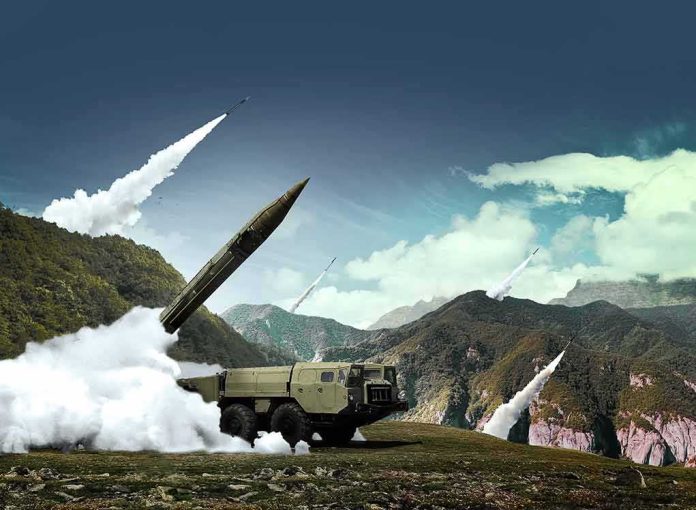
A nuclear missile launched from North Korea or Russia could hit the United States in about half an hour, leaving Americans with only minutes to react while trusting a government many already think is failing them.
Story Snapshot
- Chinese and U.S. studies say an intercontinental missile from North Korea could reach the U.S. in about 30–33 minutes.
- Russian missiles aimed at major U.S. cities are also estimated to arrive in roughly 20–35 minutes, depending on launch point.
- Experts say the U.S. president may have only a few minutes to decide whether to launch a nuclear response.
- These tight timelines feed fears on both the right and left that ordinary Americans are at the mercy of distant elites and fragile systems.
How Fast A Nuclear Missile Can Reach The United States
Defense scientists and recent studies agree on one hard truth: a modern intercontinental ballistic missile, or ICBM, can cross an ocean in about half an hour. A Chinese team at the Beijing Institute of Electronic System Engineering ran a 2023 simulation of a North Korean Hwasong-15 missile launched from Sunchon toward Columbia, Missouri, and found it would arrive in about 33 minutes. A separate analysis of nuclear war timelines also puts a North Korea-to-U.S. East Coast strike at roughly 33 minutes. For launches from Russia, defense experts estimate about 30 minutes from western Russia to the U.S. East Coast, and as little as 20–25 minutes from Russia’s Far East to cities like Seattle.
These numbers are not guesses from internet forums; they come from government-linked research centers, major news outlets, and long-standing nuclear policy groups. One study notes that from launch to destruction, a classic Cold War–style strike could take only about 1,600 seconds—just over 26 minutes. Another nuclear risk analysis explains that Russia’s nuclear-armed ICBMs can still reach the United States, and U.S. missiles can reach Russia, in under 30 minutes even decades after the Cold War. Put simply, once a hostile nuclear missile is in the air, there is very little time before it reaches an American city.
What That Means For U.S. Response Time And Ordinary Americans
Short flight times also mean short decision times for American leaders. One nuclear policy study explains that U.S. launch procedures for land-based missiles can be completed in about two minutes, and submarine-launched missiles in about twelve minutes. A separate analysis of North Korea scenarios says the president might have only about six minutes to decide on a nuclear counterattack after a launch is detected. During those few minutes, the system must correctly detect the attack, confirm it is real, tell the president, and get a decision—all while millions of ordinary citizens have no idea what is happening and no say in the choice.
For many Americans on both the right and the left, this feels like the worst version of what they already fear: faraway elites making rushed life-or-death decisions with little public oversight. Conservatives angry about globalism and wasteful spending see a nuclear system that has cost trillions yet still leaves the country deeply vulnerable. Liberals upset about inequality and lack of accountability see nuclear plans built by a tight circle of generals, defense contractors, and career officials who will be protected in bunkers while regular families are left exposed. The 30-minute nuclear window turns abstract distrust of “the deep state” into a concrete, ticking-clock problem.
North Korea’s Growing Missile Reach And Ongoing Doubts
North Korea has steadily tested longer-range missiles and claims they can hit all of the United States. In 2017, its Hwasong-14 missile flew on a steep “lofted” path for about 37–39 minutes, and analysts said that on a normal path it could reach Alaska. Later tests of more advanced missiles, including the Hwasong-15 and Hwasong-17, led Japanese defense officials to estimate possible ranges of 13,000 to 15,000 kilometers—enough to place the U.S. mainland within reach depending on warhead weight. These technical details support the idea that North Korea can now fire missiles that, at least in theory, could cross the Pacific in around half an hour.
At the same time, intelligence agencies and independent experts warn that Pyongyang often exaggerates its abilities. A leaked U.S. document said a recent North Korean missile parade “probably oversells” the real threat. Analysts also stress that many tests use high, short-range paths that prove raw power but do not fully prove reliability on real attack trajectories. In other words, the basic timing—30 to 33 minutes—looks solid, but there are still open questions about how many North Korean missiles would actually work in combat and how accurate they would be.
Russian Missiles, Submarines, And The Shrinking Margin For Error
Russia’s nuclear forces add another layer of pressure on American decision-makers. Defense simulations and media reports say an ICBM launched from western Russia could hit the U.S. East Coast in about 30 minutes, while submarine-launched missiles fired from closer positions might arrive in as little as 12 minutes. Newer Russian missiles reportedly travel at speeds above Mach 20, allowing them to reach U.S. targets within roughly 20 to 35 minutes based on where they are launched. These timelines mean that in a full crisis, multiple nations could send missiles toward the United States almost at the same time, compressing warning and making miscalculation even more dangerous.
For citizens who already doubt Washington’s honesty and competence, this tight margin for error is alarming. Many remember stories from the Cold War when false alarms nearly triggered nuclear war and were stopped only because one person in the chain of command decided to question the computer data. Today, Americans on both sides of the political aisle see a government that struggles with basic tasks—from border control to budgeting—and wonder if that same system can be trusted to handle a 30-minute nuclear crisis without a deadly mistake. The growing speed of missiles, mixed with human error and political distrust, reinforces the shared fear that the federal government is not built to protect ordinary people from the worst-case scenario.
Sources:
youtube.com, bbc.com, businessinsider.com, blog.ucs.org, reddit.com, foxnews.com, cnn.com, time.com