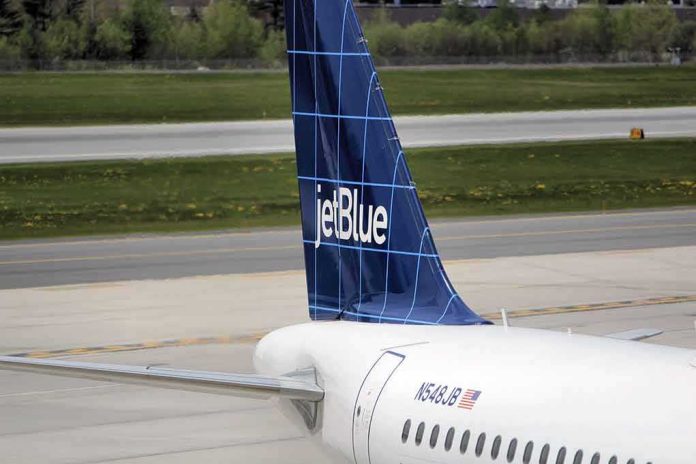
The reported JetBlue drone collision on approach to JFK is best understood not as a solved mystery but as a textbook example of how modern aviation grapples with small unmanned aircraft: highly credible pilot testimony on one side, an absence of physical evidence on the other, and a safety system that must still treat it as a serious risk.
Key Points
- A JetBlue captain reported an explicit collision with a drone at roughly 3,000 feet on final approach to JFK, describing an impact “right above the cockpit.”[2]
- The FAA confirms the report and is investigating, but post‑flight inspection found no damage or physical evidence on the aircraft.[1][6]
- This tension—strong pilot reports versus “no damage found”—matches a broader pattern in U.S. airspace where drone encounters are frequent yet rarely fully corroborated.[8][9]
- Regulation has banned drones near airports, but enforcement and technical detection remain limited, leaving airlines and regulators reliant on pilot judgment and self‑reported inspections.[8][17]
- The JetBlue case underscores a wider safety challenge: how to manage a growing collision risk from drones when the evidence around individual incidents is often incomplete.
The JetBlue Incident: What We Know and What We Don’t
JetBlue Flight 948 was an Airbus A321 inbound to JFK from Las Vegas when the crew reported striking a drone during the approach phase. Multiple broadcasts and transcripts capture the captain’s call to air traffic control: “We collided with a drone back there in the turn” and “It hit us right, right above the cockpit,” placing the event about 10–12 miles from the runway at roughly 3,000 feet. The crew told controllers they did not require assistance and continued to a normal landing, with passengers and crew deplaning without injury. In aviation reporting, those details matter: they point to a pilot who was calm, specific about location and impact point, and sufficiently confident in the aircraft’s condition to complete the flight.[2][6]
The Federal Aviation Administration (FAA) has confirmed that the pilot reported striking a drone and that the incident occurred around 3,000 feet on approach. JetBlue, for its part, emphasized that safety is its first priority and that it would assist the FAA with the investigation, while noting that the aircraft was removed from service for inspection after landing. So far, this is a familiar pattern whenever a possible drone collision is reported near a major airport: clear pilot testimony, immediate regulatory interest, and a formal inspection before the aircraft returns to service.[1][4][6]
The Counter-Claim: No Damage, No Evidence
Where the JetBlue case diverges from an uneventful “near miss” is in the apparent contradiction between what the crew perceived and what the engineers found. JetBlue’s maintenance team, in coordination with the FAA, reported “no damage or evidence of a collision” anywhere on the aircraft following post‑flight inspection. The jet was taken out of service, examined, and subsequently cleared to fly its next segment to Los Angeles—a clearance that would not be granted if any structural damage were suspected.[1][3][6]
From the maintenance and regulatory standpoint, this is strong evidence: inspections of transport-category aircraft after a suspected strike are conservative by design, and findings are formally reported. Yet the counter‑case has its own weaknesses. No independent forensic report focused specifically on the area “right above the cockpit” has been made public; there is no ultrasonic or microscopic analysis in the public record that would rule out minor paint transfer, micro‑fractures, or debris too subtle for a standard visual inspection. Nor have JetBlue or the FAA offered a detailed alternative explanation for how an experienced captain could report a tangible impact at altitude if nothing contacted the aircraft. That gap between perception and documented damage is precisely why this incident sits in a gray zone: the inspection strongly suggests no meaningful structural collision, but it does not fully explain the pilot’s experience.[1][3]
Pilot Testimony Versus Physical Evidence: How Aviation Weighs Them
Modern safety systems are built on the assumption that pilot reports are both indispensable and imperfect. A captain in final approach is managing configuration, navigation, traffic, and weather; yet experience and situational awareness often make pilots the first and best sensor for unexpected hazards such as drones. In the JetBlue case, the audio is unambiguous: the pilot did not merely report a sighting; he used collision language and described the impact point in detail.[2]
At the same time, investigators give substantial weight to post‑flight inspections because physical damage is an objective marker of an actual strike, whereas perception can be influenced by turbulence, bird activity, or even a small object passing close enough to produce a sound or visual cue without contact. This is not to question pilot competence; it is to recognize the limits of human sensing at several thousand feet in a complex visual environment. When a captain’s certainty collides with a clean airframe, regulators are forced into a nuanced stance: treat the event as serious from a safety and enforcement standpoint, but refrain from declaring a confirmed drone collision absent tangible evidence.
A Pattern of Frequent, Hard-to-Prove Drone Encounters
To understand the stakes, the JetBlue report must be set against the broader data on drones near airports. Analyses of NASA’s Aviation Safety Reporting System and related databases show that drones account for roughly half of all reported near‑midair collisions at the nation’s 30 busiest airports over the past decade, rising to nearly two‑thirds of such reports in 2023. The Associated Press has described incidents in which drones passed within 50–300 feet of airliners on approach or departure at major hubs, all classified as near midair collisions—events that could have had catastrophic consequences had the geometry been slightly less forgiving.[8][9][11]
Meanwhile, the FAA logs more than 100 drone‑sighting reports near airports every month, many of them uncorroborated by radar or video and lacking any recovered device or identified operator. In those reports, the most common narrative looks very much like this JetBlue case: a pilot sees or feels a drone near the aircraft, controllers warn other traffic, police or security assets are dispatched if feasible, and the aircraft lands safely with no visible damage. For investigators, the “no damage found” outcome is welcome but also frustrating—it avoids an accident while leaving no hard evidence to prosecute a violator or refine collision‑risk models.[17]
Regulation, Enforcement, and the Reality Near Airports
On paper, U.S. regulations make the JetBlue incident clearly illegal from the drone side of the equation whether or not a collision occurred. The FAA effectively bans drones from operating in the vicinity of airports without special authorization and limits routine recreational operations to 400 feet above ground, far below a jetliner descending at 3,000 feet. Drones above 250 grams must be registered and equipped with remote identification capability so their operators can, in theory, be traced.[8][13]
In practice, enforcement is difficult. Small unmanned aircraft are hard to detect and track in real time, especially in dense urban airspace already saturated with radar returns and radio traffic. By the time a pilot reports a drone, the device is often gone; identifying its controller, who may be operating from miles away, is harder still. That gap has prompted research into dedicated detection systems, collision‑probability modeling, and counter‑UAS technology—from RF jamming to directed‑energy concepts—to help airports protect their traffic flows. The JetBlue report, and similar near‑misses at San Francisco, Miami, and Newark, provide the real‑world scenarios for those models: drones operating illegally in approach corridors at altitudes where, in principle, none should be.[5][8]
Why “No Damage” Does Not Mean “No Problem”
It is tempting for the public to treat the absence of damage as a quiet exoneration: perhaps the pilot was mistaken, perhaps the media over‑inflated the story, and life goes on. From a safety perspective, that response is misplaced. The risk posed by drones near airliners is dominated not by the handful of confirmed collisions but by the frequency and geometry of close passes, particularly near engines, cockpit windows, and control surfaces. Studies of collision probability for intruding drones emphasize that even relatively small devices can cause significant damage if ingested into a turbofan or striking at vulnerable angles; the critical variable is not the outcome in any one encounter but the cumulative exposure across thousands of flights.[5][9][11]
In that light, the JetBlue incident reinforces several points regardless of whether a physical strike occurred. First, drones were being reported at altitudes and positions where they are prohibited, in the immediate path of approach traffic to one of the world’s busiest airports. Second, a highly trained crew judged the encounter serious enough to classify it as a collision. Third, the enforcement and detection apparatus still appears unable to identify a responsible operator or recover hardware. For regulators, the lesson is not that pilots are overreacting; it is that the system remains under‑instrumented and under‑deterrent for this class of threat.
JUST IN: JFK air traffic control is warning pilots of a *new drone sighting* just hours after the reported JetBlue drone collision. JFK's ATIS warned of a "red and white RC airplane" near the Canarsie VOR at 500 feet around 4:05 p.m. It's not clear if the cases are related. pic.twitter.com/eCKgIElWpV
— Pete Muntean (@petemuntean) June 30, 2026
Where the Evidence Leaves Us—and What Needs to Change
On the narrow question “Did JetBlue Flight 948 physically collide with a drone?” the public record is inconclusive. The captain’s testimony, captured in real time on ATC tapes, is clear and emphatic. The maintenance inspection and FAA statements indicate a structurally clean aircraft with no verifiable impact marks. Without radar traces of a small object, recovered drone debris, or forensic studies of the cockpit area, it is not possible to elevate this event beyond a well‑documented report of a suspected collision.[1][2][3][6]
On the broader question—whether drones are creating a growing hazard around major airports—the evidence is decisive. Drone encounters are now implicated in the majority of reported near midair collisions at busy U.S. hubs. Pilots are filing more than a hundred sighting reports a month near airports, despite strict regulatory bans and significant penalties. Each event, confirmed or not, forces controllers to adjust traffic patterns, consumes investigation resources, and erodes the margin of safety that commercial aviation relies on.[8][9][11][17]
The JetBlue case illustrates the limits of a system that relies heavily on pilot eyes and post‑flight inspections to manage a threat that is small, mobile, and often anonymous. Closing that gap will require more than messaging about responsible drone use. It demands investment in reliable detection around airports, routine forensic tools to investigate suspected strikes, and enforcement mechanisms that make it far less likely a drone operator can send hardware into controlled airspace at 3,000 feet and simply disappear. Until those pieces are in place, aviation will continue to live with incidents like Flight 948: unsettling, unproven, and entirely avoidable.
Sources:
[1] Web – Plane collides with drone during landing at JFK…
[2] Web – JetBlue pilot reports hitting drone while landing at New York’s JFK
[3] YouTube – JetBlue pilot reports striking drone as flight approached JFK Airport
[4] Web – NEW: A JetBlue pilot reported hitting a drone as the flight was on …
[5] YouTube – Jet Blue Plane Collides With Drone While Landing At JFK
[6] Web – A JetBlue Airways pilot reported hitting a drone as the flight was …
[8] Web – A JetBlue Airlines pilot reported smashing into a drone at …
[9] Web – JetBlue pilot reports hitting drone while landing at JFK … – Yahoo
[11] Web – JetBlue Pilot Reports Striking Drone at New York’s JFK Airport
[13] Web – DRONE STRIKE REPORTED at JFK Airport 29 JUN …
[17] Web – Rise in Drone Encounters Near U.S. Airports – AirSight