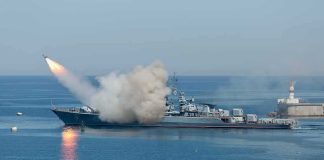
Ukraine’s low-cost sea drones are turning Russia’s once-feared Black Sea Fleet into a shrinking, defensive force—at a price tag Moscow can’t easily absorb.
Story Snapshot
- Reporting and open-source tracking indicate Russia has lost roughly 30% of its Black Sea Fleet’s combat strength since 2022, with the pace of losses accelerating after 2024.
- Key Russian ships—including the cruiser Moskva—have been sunk or knocked out of action, leaving a smaller set of offensive-capable warships in the theater.
- Ukraine’s asymmetric approach relies on relatively cheap maritime drones that can damage or destroy platforms worth tens of millions of dollars.
- Russia has shifted operations away from Sevastopol, a historic fleet hub in Crimea, reflecting growing vulnerability near the western Black Sea.
Measured Losses Point to a Real Capability Drop
Open-source reporting and Ukrainian and Western-aligned analyses converge on a basic conclusion: Russia’s Black Sea Fleet has suffered major attrition since the 2022 invasion, with estimates putting losses around 24–29 vessels—about 30% of the fleet’s combat strength. The definition of “lost” varies by source, sometimes including ships sunk, badly damaged, or withdrawn from regular operations. Even with that caveat, the trend line points to reduced offensive capacity.
The most symbolic early blow came in April 2022 with the sinking of the fleet’s flagship, the guided-missile cruiser Moskva. Over time, repeated attacks reportedly compounded the damage, especially against higher-value ships that enable amphibious operations and regional power projection. Some accounts now describe a fleet that still exists on paper but is constrained in what it can safely do. That shift matters because sea control influences everything from coastal strikes to logistics supporting Crimea.
Sevastopol’s Vulnerability Reshapes Russia’s Basing Strategy
Sevastopol in Crimea has been central to Russian naval presence for centuries and became even more important after Moscow’s 2014 annexation. Research summaries cite a meaningful operational change: Russia has relocated significant elements of the fleet from Sevastopol to Novorossiysk, roughly 250 kilometers east. Relocation does not equal defeat, but it signals risk management—moving assets farther from the reach of Ukraine’s evolving drone and strike capabilities.
That basing shift also highlights how modern precision and unmanned systems are changing the old assumptions about sanctuary ports. A fleet that must disperse or retreat spends more time protecting itself and less time blockading, striking, or threatening commercial traffic. For Americans watching global security, this is a reminder that technological change can upend prestige weapons systems quickly, and that defense planning needs to prioritize resilience over showmanship.
Cheap Drones vs. Expensive Ships: A Brutal Cost Exchange
Several reports emphasize the economics of Ukraine’s approach. Maritime drones cited in the research—such as systems reported to cost around $250,000—have been used to hit ships valued in the tens of millions of dollars. The examples referenced include attacks on vessels reportedly valued around $50 million to $60 million. When that cost exchange repeats, the burden lands not only on a navy’s order of battle, but also on national budgets already strained by prolonged war.
This dynamic resonates beyond the Black Sea. A drone-centric model lowers the barrier for a smaller power to contest a larger one, forcing expensive defenses, constant adaptation, and harder choices about where to deploy premium assets. The underlying lesson is not that big ships are obsolete overnight, but that the era of unchallenged surface dominance near hostile coasts is fading fast. In practical terms, the side that innovates faster gains leverage.
Air and Sea Losses Complicate Moscow’s Regional Influence
The Black Sea fight is not limited to ships. Research also points to significant Russian losses in aviation tied to the fleet’s broader operating area, including reports that more than half of certain Su-30SM aircraft assigned to the Black Sea Fleet’s 43rd Air Regiment have been lost since 2022. While those claims depend on wartime reporting and incomplete access, they align with a wider pattern: the closer Russia operates to Ukrainian strike reach, the higher the attrition risk.
Strategically, a less assertive Black Sea Fleet can affect Russia’s ability to pressure Ukraine’s coastline, sustain a blockade, or project influence toward the Mediterranean. It also intersects with global food security, since the Black Sea is a key corridor for grain exports. For U.S. policymakers—especially under an America First electorate that expects results, not endless spending—the core question becomes how deterrence, burden-sharing, and hard-nosed diplomacy can reduce the risk of wider escalation without writing blank checks.
"‘Circling the Drain’: Russia Has Lost 30% of Its Black Sea Fleet" – National Security Journal #SmartNews https://t.co/E3i2QNuVQY
— Kay Bruner (@bruner184644) May 2, 2026
One limitation in the available picture is that many of the most detailed claims come from Ukrainian outlets, Western analysis, and open-source compilations rather than Russian admissions. That doesn’t invalidate the data, but it does mean precise totals can vary by definition and confirmation standard. Still, when multiple independent trackers and analyses point to the same direction—substantial fleet degradation and operational retreat—the prudent takeaway is that the Black Sea balance has shifted in measurable ways.
Sources:
Circling the Drain: Russia Has Lost 30% of Its Black Sea Fleet
Russia’s fleet sinking: Ukraine inflicts major naval losses in Black Sea war — MoD
Russia lost more than half of Su-30SMs in the 43rd Air Regiment of the Black Sea Fleet since 2022
Fleet in decline: Russia’s biggest naval losses in the Black and Azov seas
List of ship losses during the Russo-Ukrainian war