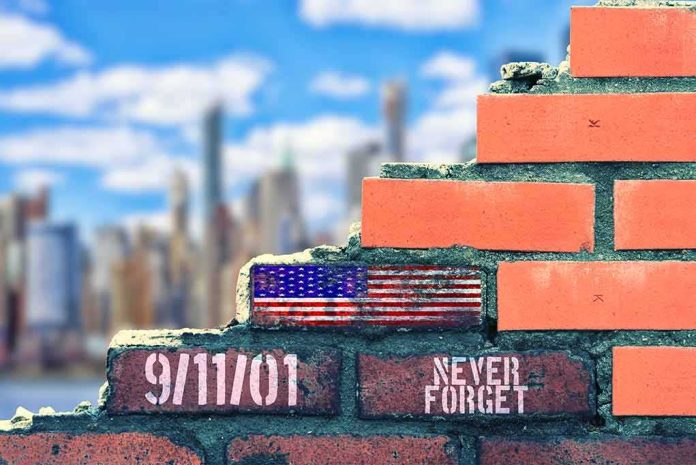
The lasting truth of 9/11 is not only that it was a mass-casualty attack; it reset how the United States organizes security, balances liberty and surveillance, and remembers public service—changes that still structure daily life a quarter century on.
The Short Version
- 9/11 catalyzed a permanent redesign of U.S. security architecture, doctrine, and interagency coordination.
- Civil liberties and surveillance norms shifted measurably under laws and practices built “for the next attack.”
- The health and psychological burdens on survivors and responders have proven enduring, not episodic.
- Public memory linked sacrifice to service, sustaining recruitment and civic participation.
9/11 as a structural breakpoint, not a one-day tragedy
From the first hours, national leaders framed 9/11 as a new condition to be managed, not a discrete crisis to be endured. The presidency’s language set the template: immediate care for victims, coupled with a mandate to protect Americans “at home and around the world from further attacks.” That dual track—consequence management and prevention—became the doctrine of the early 2000s and justified swift, far-reaching changes across intelligence, law enforcement, and military posture. Within a year, commemorative rhetoric hardened into policy: officials repeatedly cast 9/11 as a “fixed point” in American life, a statement of permanence that signaled to agencies and appropriators that this was a long war, not a passing emergency.
The 9/11 Commission captured this logic in prescriptive form. Its executive summary called for a global strategy that combined direct action against terrorists, suppression of organizational regrowth, and deep investments in prevention and preparedness—specifically, unity of effort across institutions that had previously guarded their seams. That recommended “unity” was not metaphor; it was an operational ask that drove new structures, new authorities, and new reporting regimes in the years that followed.
How the security state was rebuilt—mechanisms and institutions
Institutionally, the most visible consequence was consolidation. The federal government created a new department centered on homeland defense tasks, knitting together functions that had been scattered and sometimes duplicative. The administration’s own retrospective speeches emphasized “unprecedented actions” and a new department to defend the homeland—shorthand for a rebalanced enterprise that pushed information sharing, joint task forces, and common operating pictures to the fore. By a decade on, the Department of Homeland Security was documenting progress along 9/11 Commission lines: watchlisting, transportation security, layered vetting, and state-local integration were no longer pilots; they were baseline expectations of governance,.
Just as consequential were the reporting and oversight mechanisms that matured in 9/11’s wake. Congress wrote into law routine transparency around algorithmic tools with the Federal Agency Data Mining Reporting Act—requiring annual disclosures from agencies engaged in data-mining activities, including when those activities are performed by contractors “on behalf of” the government. That statute did not end debate over surveillance; it institutionalized it, forcing an ongoing accounting of techniques that, before 2001, would have been both rarer and largely invisible to the public record.
Security versus privacy—the post-9/11 surveillance bargain
The most persistent domestic tension has been the balance between preemption and privacy. The USA PATRIOT Act and related authorities expanded government access to records, sanctioned delayed-notice searches, and broadened communications monitoring under lower thresholds than pre-9/11 practice—steps animated by the fear of coordinated, multi-node plots. Scholarship since has argued that this expansion challenged liberal democratic norms about individualized suspicion and proportionality; the central claim is not that surveillance began after 9/11, but that its scale and routinization did, with lasting downstream effects on expression and association. Legal analyses similarly trace how signals intelligence programs, justified by the imperative to “connect the dots,” collected large volumes of data on U.S. persons as part of risk triage designed to surface the rare adversary pattern hiding in the ordinary stream.
This is the shape of the tradeoff the country made: an architecture built to reduce catastrophic tail risk will, by design, pull more information into government systems and keep it longer. The argument that followed—congressional sunsets, inspector general audits, court challenges—has been about calibration, not eradication. And the oversight scaffolding built since, including mandated data-mining reports, is evidence that the surveillance bargain did not go unscrutinized; it was contested and refined in public view.
Enduring human costs—health, grief, and civic behavior
The legacy is not only institutional. For survivors, responders, and bereaved families, 9/11’s health and psychological burdens proved long tail rather than short spike. Longitudinal research shows that post-traumatic stress symptoms tied to the attacks persisted for years, with a relatively stable pattern for at least six years among affected cohorts—evidence that the mental health impact was durable, not transient. Clinical and qualitative studies of those injured, especially recovery workers and civilians who experienced life threat and mass-casualty scenes, document chronic respiratory illness, suboptimal care pathways, and the difficulty of reintegration—reminders that “recovery” in mass trauma is a process measured in decades, not months,.
Political behavior also shifted in discernible ways. A careful study of victims’ families and proximate neighbors found sustained increases in political participation and a rightward movement in party affiliation over a 12-year span—an effect attributable to the attacks rather than generic cohort drift. In the aggregate, public salience measures tell a similar story: one year after the attacks, 80% of Americans, asked openly, named 9/11 as the most important event of the prior year; decades later, reputable institutions still list the attacks among the defining markers of the era,. Memory endured because lived consequences did.
War, strategy, and the redefinition of “safety”
Abroad, the United States adopted an offensive counterterrorism posture geared to deny sanctuary, disrupt networks, and degrade leadership—a strategic throughline evident across administrations. Early addresses made the point succinctly: this was a war unlike previous wars, with a moving adversary and a preventive aim—“safer, but not yet safe” became the national watchword. Operationally, that meant Afghanistan and, controversially, Iraq; academically and morally, it meant reckoning with the cost of protracted conflict and the indirect deaths, displacement, and polity-level shifts such wars drive,. Even as specific theaters changed, the doctrine of anticipatory disruption—finding and fixing plots before they mature—remained the consensus baseline among practitioners, the import of which is visible in how threat reporting, interagency fusion, and foreign partnerships are funded and measured today.
The new exhibit at the 9/11 Memorial: “In Their Honor: 25 Years of 9/11 Inspired Service,” explores the legacy and enduring impact of service inspired by the national and local response to Sept. 11, 2001.https://t.co/8fOJC4FsDN https://t.co/9U1QrcIPwg pic.twitter.com/1rJ1Bkwplu
— NYC EMS Watch (@NYCEMSwatch) August 31, 2026
Service, remembrance, and the civic throughline
Anniversaries of 9/11 have never been only elegiac; they have been calls to service. Presidential commemorations at the Pentagon and in New York have consistently tied mourning to mission—honoring the nearly 3,000 murdered while emphasizing resilience and the preservation of the American way of life,. That framing was not empty rhetoric. It coincided with a surge in uniformed and civilian service that leaders have continued to highlight, depicting a generation that chose military, intelligence, law enforcement, emergency response, and community service roles in direct response to the attacks. Two decades on, museums and memorial foundations curate this theme explicitly: sacrifice inspiring service, service reaffirming national identity.
What endures—and why it still matters
To understand the world built after 9/11 is to see the logic that tied so many disparate changes together. The United States constructed an operating system for rare but devastating risks: new departments and authorities to break silos; oversight mechanisms to domesticate powerful surveillance tools; strategy that prizes preemption abroad; and civic rituals that bind grief to duty. None of this is static. Authorities sunset, courts revise, technologies evolve, and geopolitics shift. But the chassis remains. When officials say September 11 is a “fixed point,” they are describing the anchor for a generation’s worth of decisions that followed—and the reason they still frame safety as a condition to be managed, never declared complete,,.
Sources:
youtube.com, trumpwhitehouse.archives.gov, presidency.ucsb.edu, avalon.law.yale.edu, georgewbush-whitehouse.archives.gov, britannica.com, ojp.gov, pmc.ncbi.nlm.nih.gov, pubmed.ncbi.nlm.nih.gov, repository.upenn.edu, academiccommons.columbia.edu, muse.jhu.edu, pewresearch.org, bu.edu, dhs.gov, scholarlycommons.law.hofstra.edu, apa.org