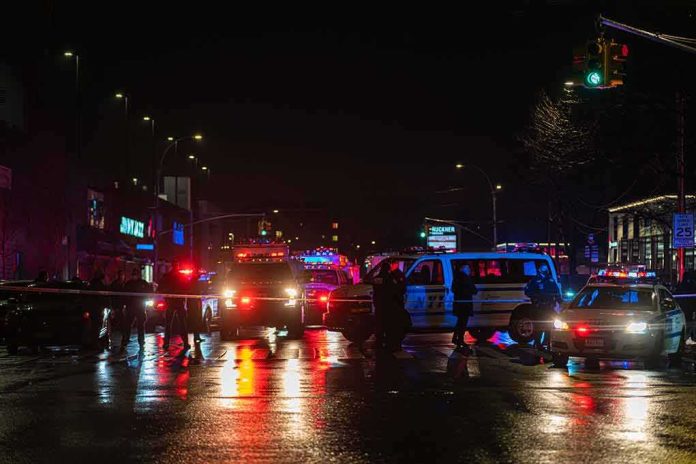
In the first hours after a mass-casualty shooting, numbers can look chaotic; in Minneapolis, the essential facts ultimately aligned quickly and clearly: three people were killed, six others were injured, and among the wounded were multiple Minneapolis police officers responding under fire.
The Short Version
- City officials reported three fatalities in the Loring Park area shooting and multiple additional injuries.
- Three Minneapolis police officers were injured; two were treated at HCMC and one required surgery, according to the city’s initial release.
- Early newsroom tallies converged on the same structure: two victims killed plus the suspect dead, with officers among the wounded.
- Fluctuations in early casualty counts are common in mass-casualty events; reconciliation typically follows as police and hospitals finalize records.
What Happened: The Core Facts That Stood Up
Authorities said a shooting in Minneapolis’ Loring Park area left three people dead and several others injured. The city’s public release specified that three Minneapolis police officers were among the injured; two were being treated at Hennepin County Medical Center (HCMC), and a third officer was in surgery at the time of that notice. Independent reporting from wire and local outlets described the same silhouette of the event: multiple victims, two civilians deceased, and the suspect also dead—bringing the total fatalities to three—with officers among those hurt and transported to care. Those elements, the ones that matter most for a clear public understanding, held consistent as the dust settled.
In practical terms, that means responders managed an active-threat environment inside or adjacent to a multi-unit residential structure, absorbed incoming fire, extracted casualties, and neutralized the suspect. The presence of HCMC—Minnesota’s flagship level I trauma center—minutes from downtown Minneapolis is critical in such scenarios; survivability in mass shootings correlates strongly with time-to-definitive-care, and downtown Minneapolis has an unusually short prehospital-to-trauma-center interval, which helps explain why a high volume of gunshot victims can still translate into a relatively stable mortality count once the event ends.
Why Early Numbers Move — And Where They Land
Confusion in the first hour is not a sign of evasiveness; it is the product of parallel data streams that have not yet converged. Police triage tags, radio traffic, and incident command logs represent one stream; hospital intake and trauma activations represent another. The initial public-facing number often reflects the floor of confirmed casualties, then ratchets as hospitals report who arrived, which injuries count as gunshot wounds versus other trauma, and whether deaths occurred at the scene or upon arrival to the emergency department. Seasoned editors and public information officers treat those first tallies as provisional for good reason; decades of breaking-news postmortems show that early counts, while necessary for public awareness, are “often wrong” in the details and then reconciled within hours as records are cross-checked.
The Minneapolis case followed that familiar arc but with relatively fast convergence: city communications established the three-fatality frame, and mainstream reports cohered around two victims plus the deceased suspect, with six others injured and officers among the wounded. That alignment is typical when an incident remains geographically contained (a single building or block), a single agency maintains incident command, and a regional trauma center consolidates the bulk of transports—conditions that shorten the reconciliation window.
Mechanics of the Police Response in Vertical, Constricted Space
Active-shooter doctrine since Columbine prioritizes immediate interdiction—push past the sound of gunfire, isolate or eliminate the threat, and enable rescue. High-rise or mid-rise structures complicate that template. Stairwells create fatal funnels; elevators are unpredictable and tactically risky; line-of-sight is short and angles multiply. Officers must also balance two conflicting imperatives: advancing toward the shooter to stop the killing and peeling off personnel to establish casualty collection points and evacuate the wounded under protection. That tradeoff is why you see multiple officers injured in these settings; they are absorbing risk that keeps medics and evac lanes viable.
In Minneapolis, officers were reported under sustained fire while moving victims to safety, a detail that’s consistent with the injury profile—two officers with gunshot wounds and a third injured during response—and with the city’s accounting of officers in hospital care. It tracks with after-action analyses from similar incidents: tighter hallways, hard corners, and doorways increase both contact probability and the likelihood that first-wave responders, not later-arriving tactical teams, will take hits while executing rescues.
How This Fits the National Pattern Without Distorting It
Mass shootings are a statistical thicket. Definitions vary—some require four or more fatalities; others count four or more people shot, regardless of death—which means datasets do not always agree on what “counts.” A systematic review of leading databases shows enormous spread in incident totals precisely because inclusion criteria differ. For the public, that variance obscures real trends and complicates civic debates. What does cut through the fog is the operational reality that drives outcomes: distance to trauma care, the speed and training of the police response, and whether the event unfolds in open or vertical-constrained space—variables that help explain why two superficially similar incidents can yield very different casualty patterns.
Local TV injury reporting tends to emphasize visuals over medical precision; historically, that means more airtime for the dramatic scene and less for the slow, careful work of reconciling injury counts with hospital records. Responsible coverage, and responsible consumption of it, acknowledges that early numbers are signals, not verdicts, and that the official ledger will harden as agencies synchronize their logs. That is not a dodge; it is the way complex incident accounting works in the United States, from urban shootings to large-scale disasters.
What Endures After the Headlines
When you strip out the noise, three durable takeaways remain. First, the Minneapolis incident fits a now-familiar urban pattern: a fast police push into a confined structure, a suspect neutralized, and a casualty count concentrated early, with trauma-center proximity limiting additional deaths. Second, officers get hurt when they take the shortest path between victims and care; that is a policy choice embedded in modern active-threat doctrine, and it saves lives at the cost of officer risk. Third, credibility lives in reconciliation; the city’s formal bulletin and mainstream wire-style reporting ultimately pointed to the same facts, and those facts—three dead, six injured, officers among the wounded—are the right frame for understanding what happened and what it demanded of responders.
Events like this will recur, and the numbers will move in the first hour before they settle. That is the nature of emergency operations and real-time journalism, not a sign that the center cannot hold. In Minneapolis, the center did hold: the threat ended, the injured reached care quickly, and the public record converged on a clear account of a grim afternoon and the people who ran toward it.
2 Killed, Suspect Dead After Minneapolis Shooting.
At least two people were killed and six others were injured in a shooting in Minneapolis on Wednesday. The shooter was killed.
The Minneapolis Police Department said two of its officers were among those wounded. Officials… pic.twitter.com/49aZTQKWg5
— NTD News (@NTDNews) September 3, 2026
Sources:
youtube.com, patch.com, content.govdelivery.com, minneapolismn.gov, foxnews.com